
When Neumann invites us to the Abbey Road Institute in Suresnes, we are of course happy to accept. It is already a pleasure to return to one of the finest studios in the Paris area, Omega Studios, formerly Studio Mega, and the interest rises another notch when the German manufacturer offers us a preview of two new studio monitor models, along with a look back at the history of its microphones and the reissue of several classics.
Guiding us through the afternoon are Roman Kramer (Product Manager Monitoring) and Rune Jacobsen (Product Marketing Manager) for Neumann, Charly Fourcade (Application Engineer with the Sennheiser France team), and Pierre Jacquot, sound engineer, trainer and long-time Neumann microphone user.
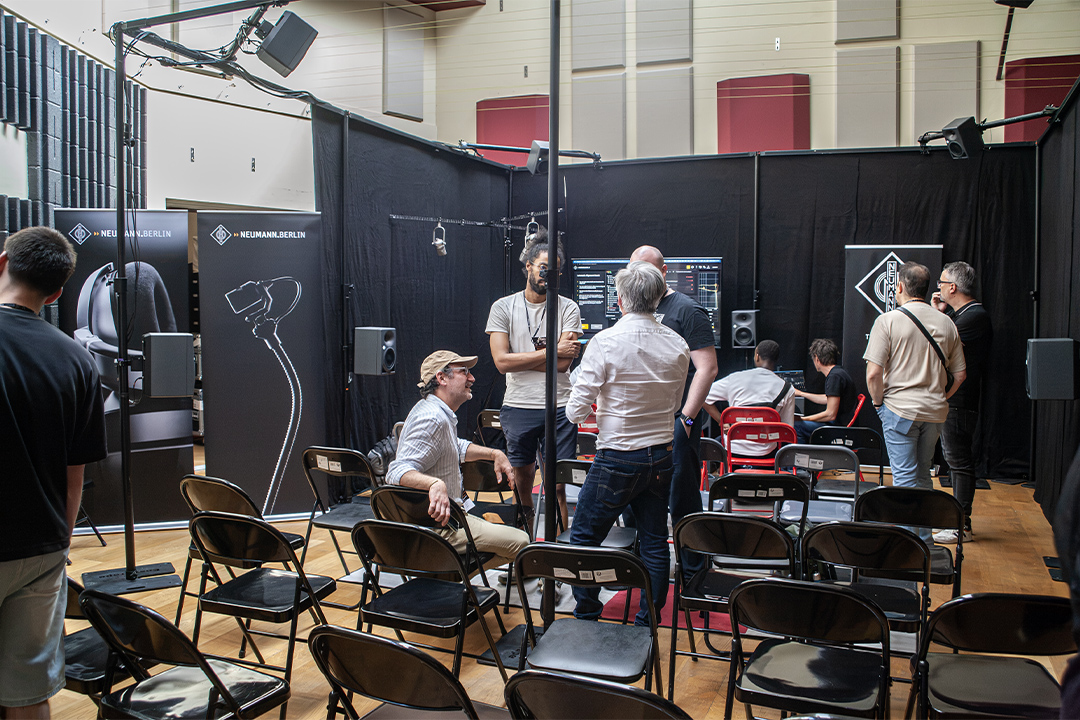
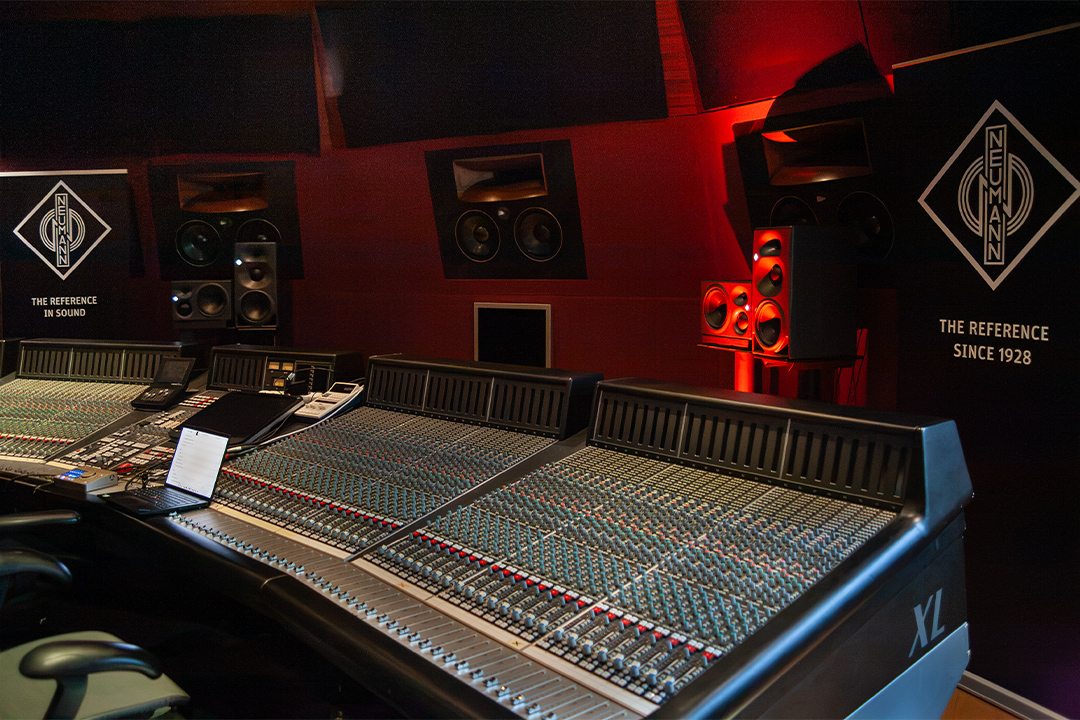
For the presentations, we take our seats in a 7.4.1 monitoring setup that, among other things, highlights the capabilities of Neumann’s MA 1 automatic calibration system. Here, seven KH 150 loudspeakers are used as the main and surround monitors in the horizontal plane, with four KH 120 II units overhead and two KH 870 II subwoofers for LFE and bass management.
At the heart of the system is a Neumann MT 48 audio interface, linked over IP via Dante or Ravenna to the loudspeakers, all AES67-compatible through a standard network switch. The interface also acts as the monitoring controller, managing level, sources, speaker sets and downmixes.
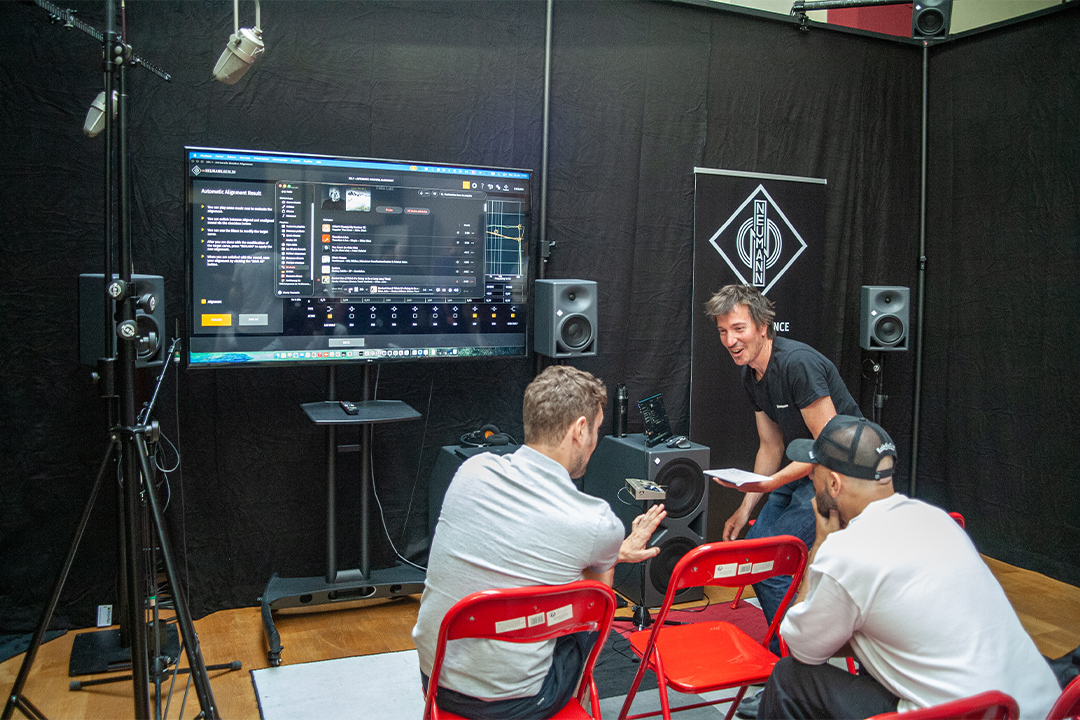
Acoustic alignment with MA 1 fundamentally changes the perception of the sound field by removing the sense of discrete physical sources, as Charly Fourcade explains: “In a multichannel monitoring system like this, you are no longer listening directly to loudspeakers, but rather to the sound sphere and to the continuity of moving audio objects.
The processing defined by MA 1 amplitude, delay and phase correction is carried out directly in the loudspeakers’ DSP rather than in software, avoiding any risk of added latency and ensuring that the calibration remains embedded in the monitoring system. Even in an acoustically treated room, the time-domain correction provides an essential increase in precision.”
The immediate comparison with and without calibration clearly demonstrates the quality of the analysis performed with the calibrated microphone and the multipoint measurement procedure. Offered at a very accessible price, it appears to be a particularly worthwhile upgrade for users of compatible Neumann monitoring systems.
Before listening to the two new loudspeaker models in stereo in the main studio control room, we meet Roman Kramer and Rune Jacobsen, who explain the overall philosophy behind Neumann’s monitor development.

For Neumann, professional monitoring is not about piling up advanced technologies. Its primary purpose is to build confidence for the user. A sound engineer should be able to finish a mix knowing how it will translate to other systems, without constantly checking against alternative references. In today’s studios, where time and budgets are under constant pressure, reliable tools make it possible to take the right decisions quickly.
“A studio monitor is a tool for the sound engineer. It is not supposed to sound sophisticated or altered; it must be as transparent as possible so that what the engineer hears is as close to reality as possible,” Roman Kramer explains. “That is why Neumann focuses on frequency linearity and makes sure the tonal balance remains perfectly stable, whether you listen at low or very high levels.”

Another distinctive aspect of Neumann’s monitoring philosophy, highlighted by Rune Jacobsen, is the refusal to create multiple product ranges with different sonic signatures: “Neumann follows one consistent philosophy: whether you are listening on a small nearfield monitor or a larger studio monitor, the overall tonality must remain rigorously consistent. The only physical differences should be maximum sound pressure level and low-frequency extension.”
Roman continues: “Although technology now helps us with modeling—such as computer-optimized waveguide shapes—the human element remains at the heart of the process. Computer simulations do not replace intensive listening tests. A great many human ears are involved in the development of our studio monitoring systems.”
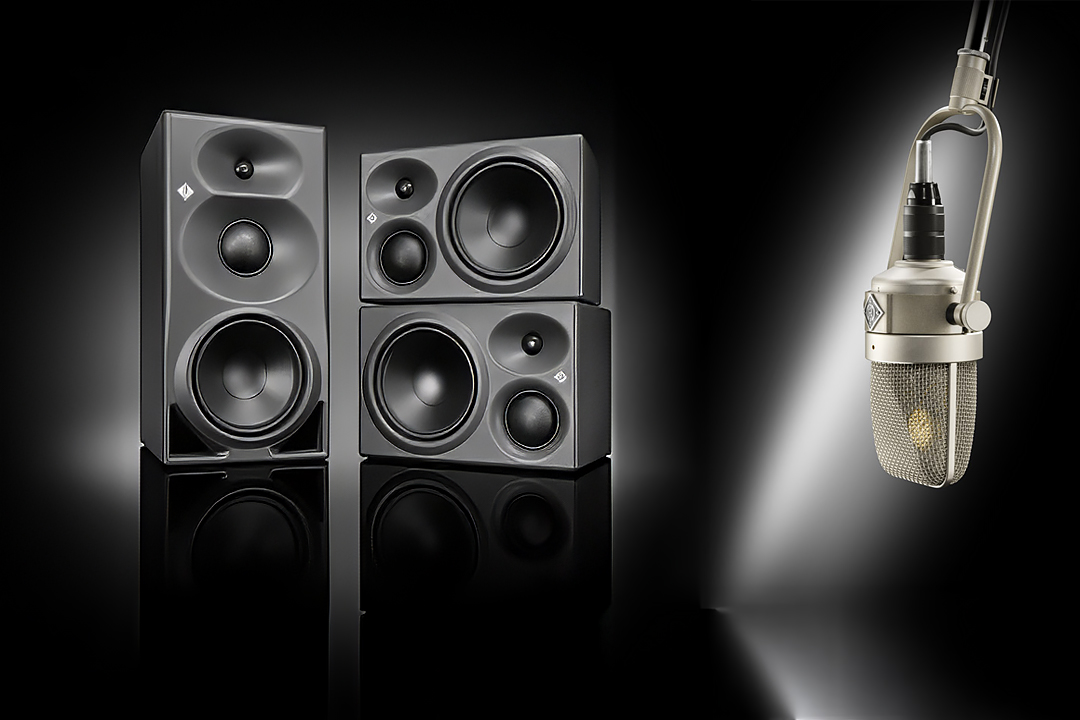
Speaking of human ears, it is time to bring ours into the studio to hear Neumann’s two new loudspeakers: the KH 310 II, a major evolution of the well-known KH 310, and the KH 350, which reinterprets the KH 310 concept in a bass-reflex design. The new KH 310 II retains the previous model’s compact horizontal sealed enclosure and the same transducers, including the legendary 3-inch soft-dome midrange driver, still a benchmark for vocal definition and midrange intelligibility. The main change is a complete redesign of the electronics.
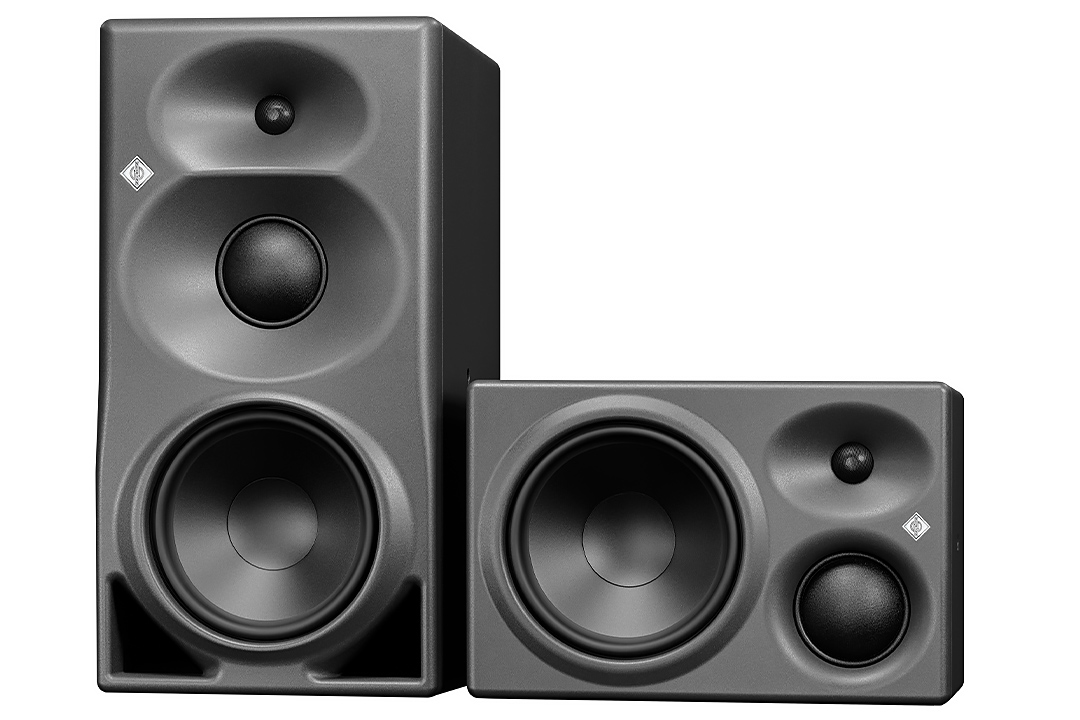
Roman Kramer explains: “The R&D team’s main objective was to improve the loudspeaker without changing its sonic identity. We therefore kept all of its acoustic components and completely redesigned the amplification and processing platform to deliver major improvements in ease of use.” All the changes in this new version are therefore purely electronic and internal. They include integrated DSP for acoustic calibration and new Neumann-designed Class-D amplifiers which, with almost twice the power, provide an additional 5 dB of dynamic headroom and raise maximum SPL to 121.4 dB.
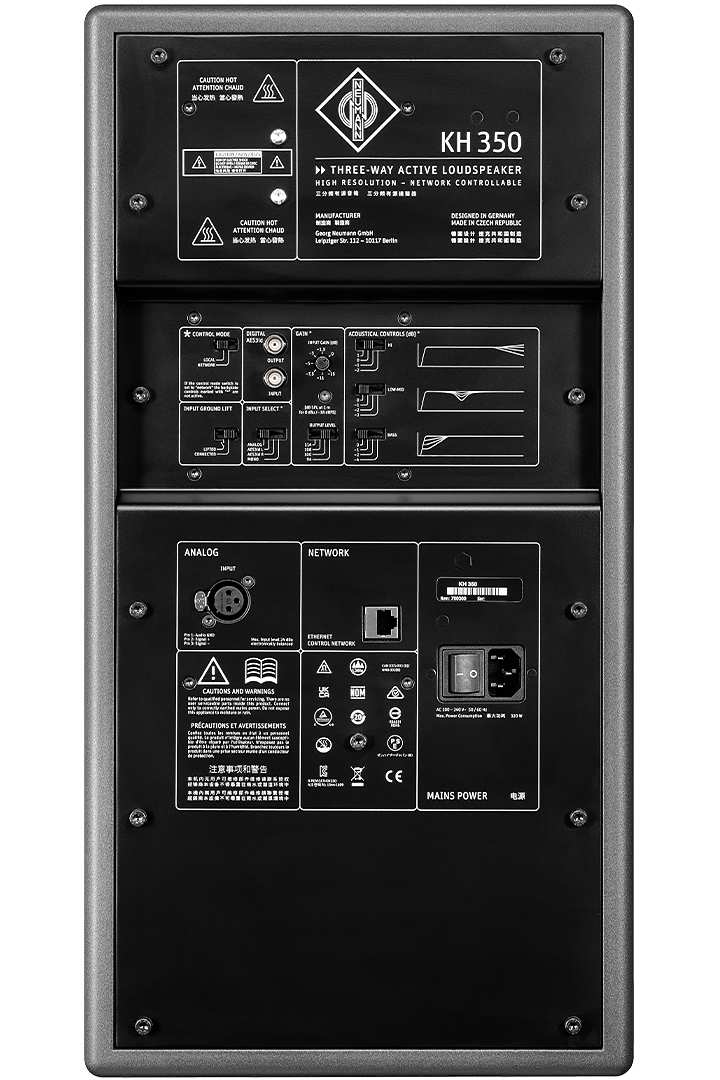
The new KH 350 is radically different in its enclosure and acoustic design. Although it shares the KH 310’s transducers and electronic platform, its vertical bass-reflex cabinet and doubled enclosure volume immediately deliver greater low-frequency efficiency, with extension down to 27 Hz and a maximum SPL of 122.6 dB. Roman Kramer explains: “The impact in the low end is considerably stronger. One decibel may not sound like much, but when you look at the sound pressure level between 20 and 50/70 Hz, the actual difference in impact is much greater.”
The KH 350 uses an MMD (Mathematically Modeled Dispersion) waveguide for the midrange driver, redesigned to modify its directivity and optimize it for a longer listening distance around 3 meters, compared with 2.5 meters for the KH 310.
“The vertical layout changes the physical environment around the midrange driver and its new waveguide,” Roman explains. “Measurements on the vertical axis show excellent frequency distribution from 500 Hz upward. This controlled directivity is fundamental to achieving extremely precise imaging and source localization. In multichannel or immersive configurations such as Dolby Atmos, poor directivity creates interference and degrades localization. The KH 350 format addresses that issue, making it an ideal choice for immersive systems and as a midfield monitor for a more distant listening position.”
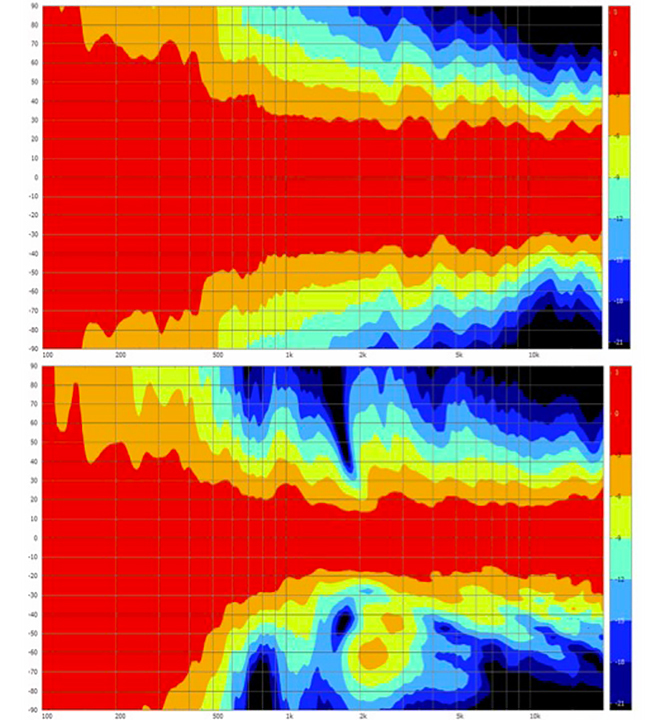
Listening to the two new models, the difference in design is immediately apparent in the low frequencies. The KH 310 II retains the tight, precise bass character of a sealed enclosure, albeit with a limit in output, while the KH 350’s vertical bass-reflex design and doubled cabinet volume deliver substantially greater low-end impact.
Of course, the intended applications of the two monitors need to be kept in mind in this comparison. The KH 310 II is perfectly at home as a nearfield monitor, while the KH 350, with greater output, deeper bass and controlled directivity, fully assumes its role as a midfield monitor, while remaining equally usable at close range.
Using the same transducers helps preserve the sonic identity of both models as closely as possible. This is a useful advantage when different monitoring systems are used within the same studio, or across a multi-room facility where tonal consistency can be maintained. The KH 350’s more expansive low-frequency behavior and higher SPL capability must, however, be taken into account by the engineer.
The manufacturer’s aim is clearly to create monitoring systems that are as neutral and transparent as possible, so they do not mislead professional judgment. Both loudspeakers meet that brief, introducing very little sonic coloration. In pursuit of complete transparency, both models include onboard DSP so they can be calibrated with the MA 1 system described earlier. It uses a hybrid combination of FIR (Finite Impulse Response) and IIR (Infinite Impulse Response) filters to achieve extremely precise phase alignment while maintaining near-zero latency.
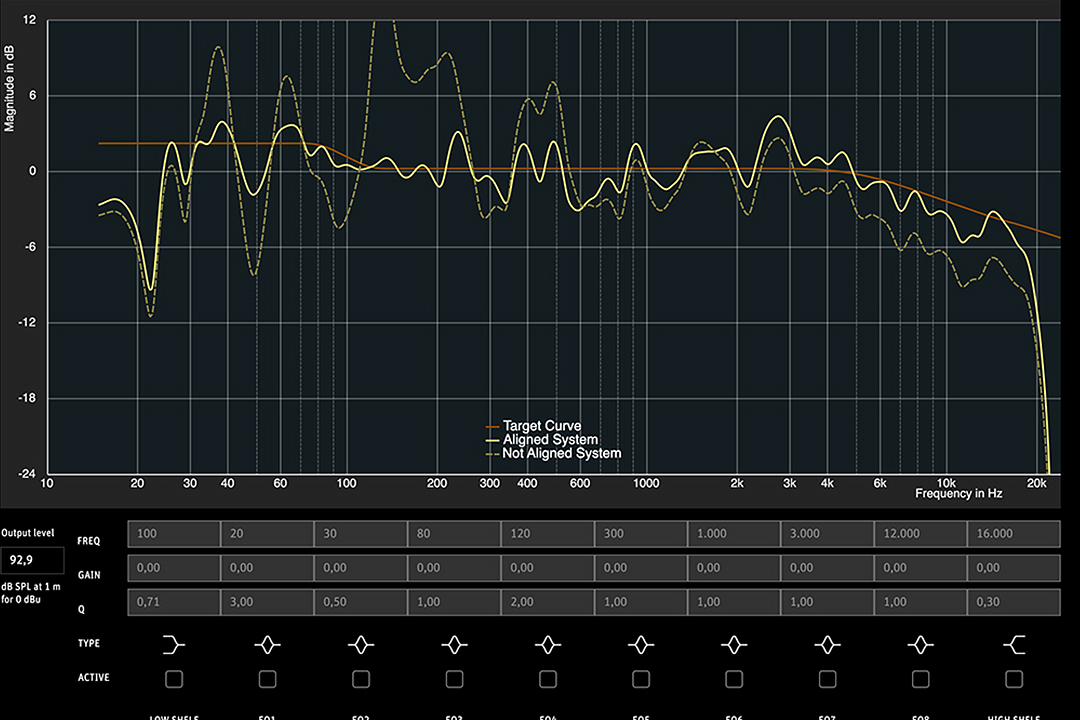
“The calculations and the time compensation for the delay introduced by the filters are built directly into and managed by the loudspeaker’s internal processor,” Roman explains. “This hardware integration eliminates the latency issue in the monitors.”
If monitor quality is essential… the same is true of microphones

Studio monitors play a critical role by converting the “electrical” signal back into the acoustic domain; microphones perform the reverse task, capturing acoustics and converting them into an electrical signal. Neumann has excelled for decades at designing studio microphones that have become legends. This is the second part of our afternoon.
Original vintage Neumann microphones can still be found on the market, but their prices can be prohibitive and maintenance is highly uncertain, with some components—especially tubes—now almost impossible to source.
“The AC 701 tube used in the M 49 has been out of production for a very long time and is now extremely rare,” Pierre Jacquot explains. “When you find one, it sells for around €2,000, and there is no real guarantee that it will work. And the VF14 used in the U 47 is even worse—production stopped in the 1960s!”
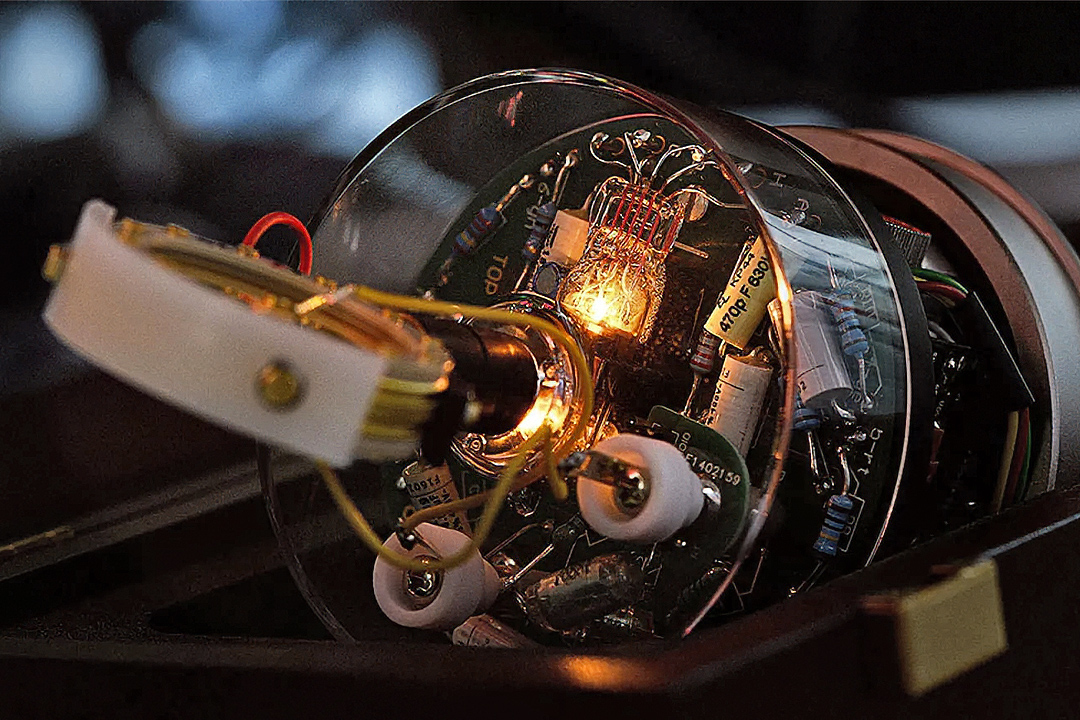
Given the enduring success of its legendary microphones, Neumann has resumed production of several iconic models: the U 67, M 49 and M 50. Such a move is unusual for a manufacturer and has been widely welcomed throughout the industry. The task is complex, and Neumann had to overcome numerous technical, physical and economic challenges to make the reissues as faithful as possible.
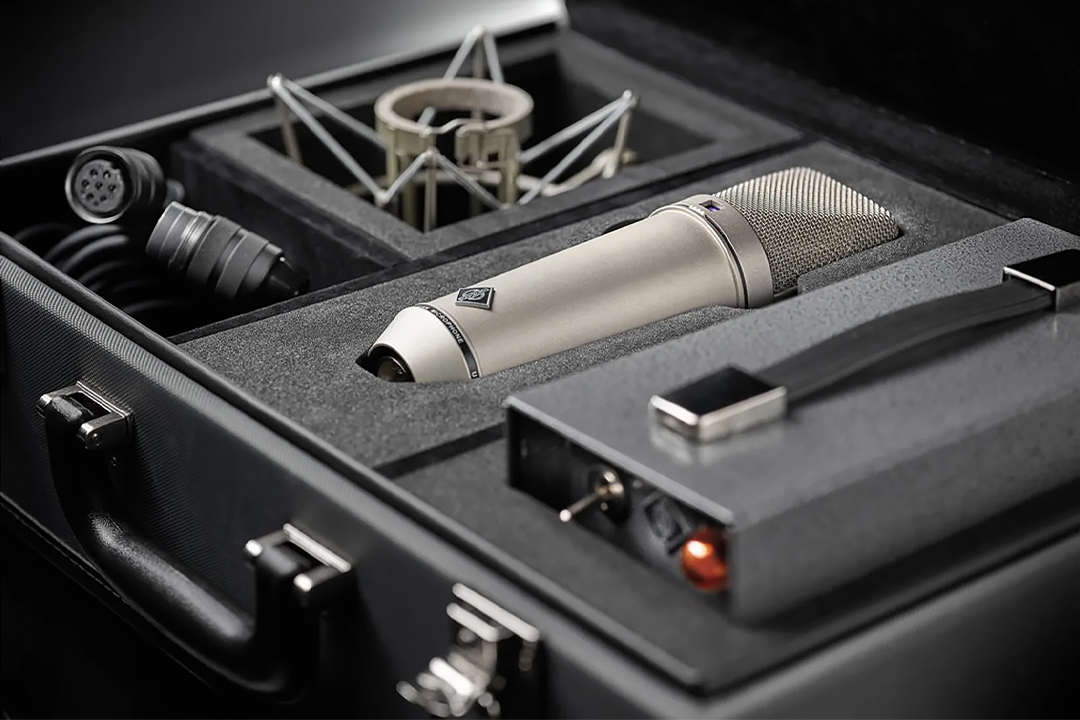
Pierre Jacquot, one of the first beta testers of these reissues and an owner of the original models used for direct comparison, confirms the success of the project: “There is no noticeable difference in the fundamental sonic character or color between the vintage originals and the modern reissues. The core acoustic characteristics have been preserved. I would describe the new versions as ‘a touch cleaner,’ which makes them very well suited to the digital recording era. By slightly lowering the original noise floor, these microphones provide greater dynamic range, making them easier to work with today.”
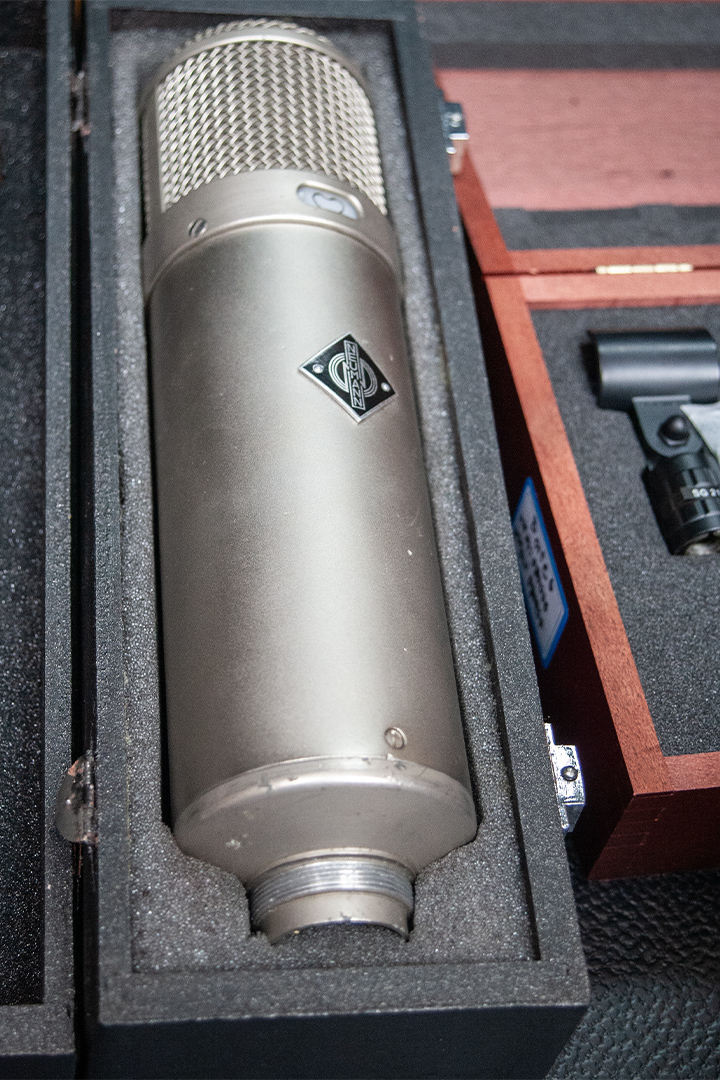
To achieve this, Neumann developed a new modern miniature tube whose physical characteristics and acoustic behavior are extremely close to the legendary AC701 used in the M 49 and M 50. The new tube produces even less heat, is quieter, offers a better signal-to-noise ratio, has a much longer service life and is far less expensive to replace under €300.
Unfortunately, one major Neumann vintage model—the famous U 47 cannot use this new modern tube. For now, at least, it is therefore excluded from the possible reissues.
“The new Neumann tube cannot be used to rebuild a vintage U 47,” Pierre Jacquot explains. “The way the original VF14 operates is almost a physical contradiction: it is a pentode wired as a triode and run at reduced voltage, which makes replacing it with a modern component extremely complex.” Collectors therefore still have plenty to look forward to, and the mythical U 47 will remain a highly sought-after object.
The U 67 was the first vintage microphone to be reissued, in 2018. Introduced in the 1960s, this studio standard has remained an essential reference in many of the world’s leading recording facilities. Many readers will undoubtedly have had the pleasure of using one. Its exceptionally silky sound remains one of the reasons it is still among the most sought-after premium microphones.
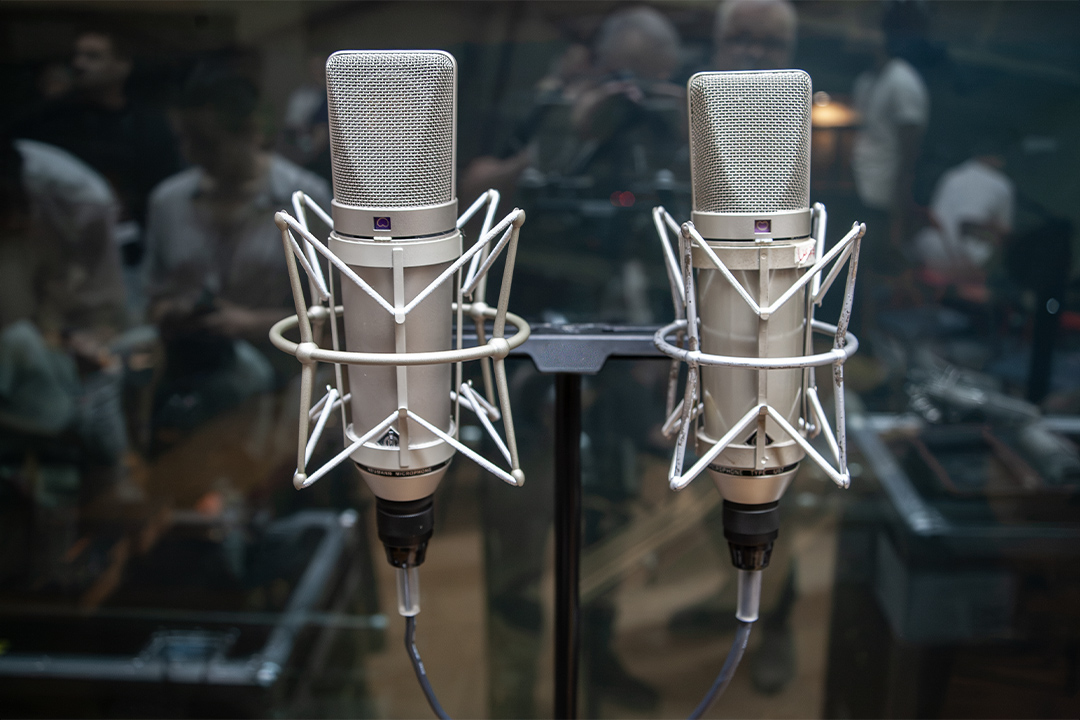 Vintage U 67 on the left, its reissue on the right
Sonically, the current U 67 SET reissue uses a capsule and electronic design identical to the 1960-1971 model. Critical parts such as the BV 12 output transformer are reproduced with great care, and the still-available EF86 tubes are individually selected. The success of the U 67 reissue led Neumann to continue the project with two other essential models, the M 49 and M 50.
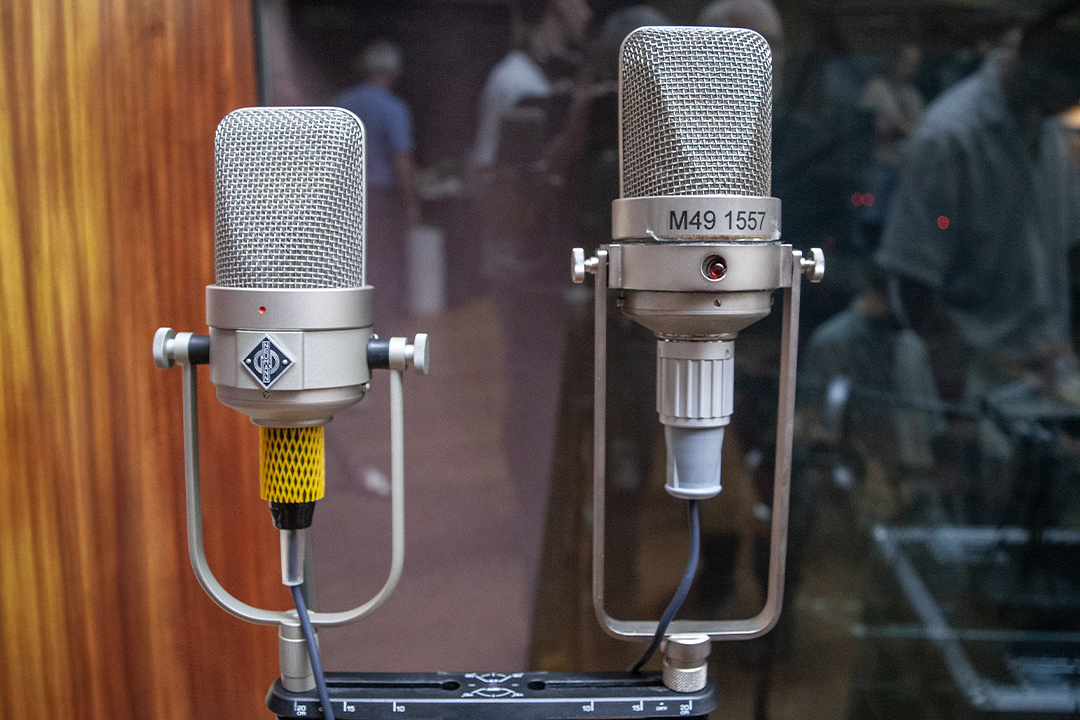
The M 49 is a legendary microphone with an unusual design that allows its polar pattern to be varied continuously from the external power supply, progressively covering every intermediate pattern between omnidirectional and bidirectional. The earliest models used the M7 capsule, which did not age well on its PVC/Mylar support, before Neumann moved to the improved K49 capsule.
That capsule is still used in the M 49 V reissue. Only the original AC701 tube – rare and fragile – has been replaced by the new miniature tube. The power supply was redesigned for the new tube and for gradual warm-up, while the connectors were modified to provide sufficient immunity to interference in modern studio environments.
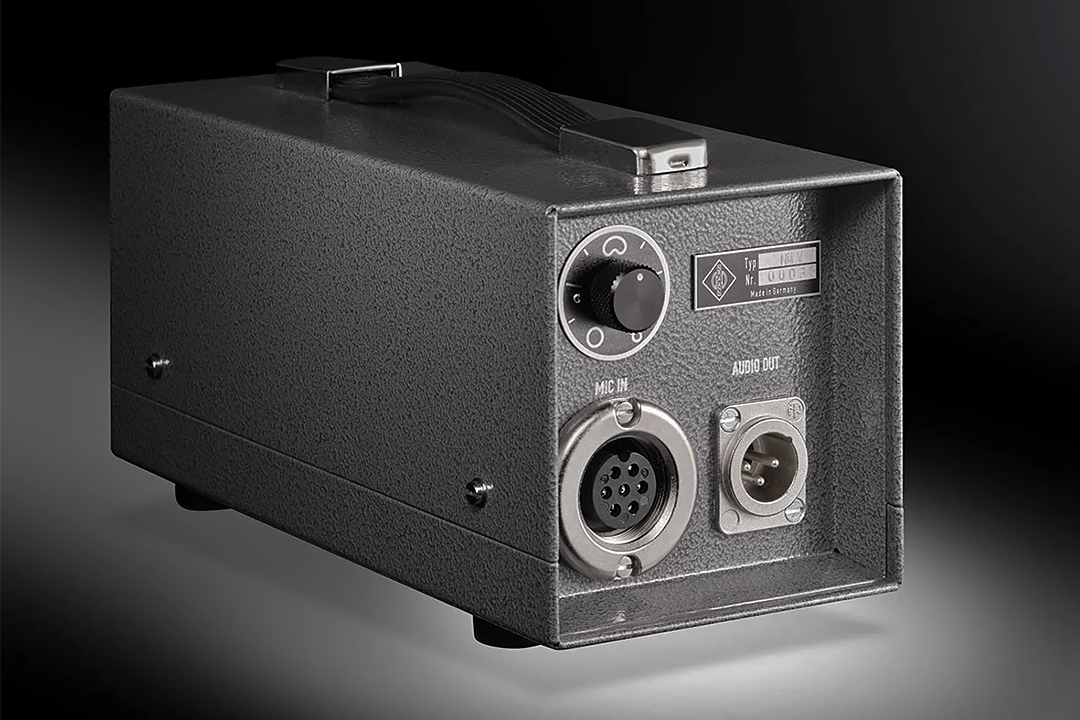
Pierre Jacquot praises the quality of this modern reissue and says that, after comparing it with his own 75-year-old M 49 C, he heard no difference in sonic color or fundamental character. He does, however, point out one important consideration: “The fact that the reissues are technically a little quieter can paradoxically unsettle users who know the vintage models well.
With an old Neumann, engineers have internalized the fact that at -60 dB the signal is not completely clean. Changing that behavior and removing the background noise subtly changes the psychoacoustic relationship an engineer has with these old transducers. It is still a necessary evolution in the digital era, where microphones have to operate over a much wider dynamic range.”
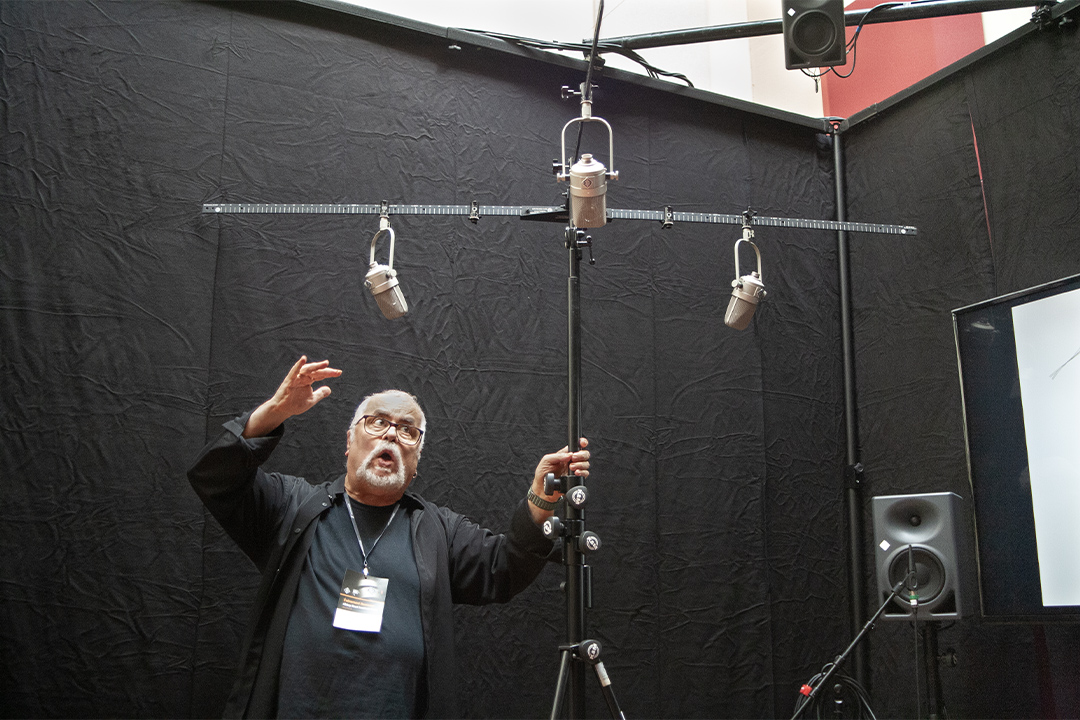
Although the M 50 shares the same visual language as the M 49, it is a very different microphone in both characteristics and application. It was designed in 1951 in response to Decca engineers using a specific recording technique: the Decca Tree. This uses three omnidirectional microphones, with two on the same line spaced from at least 80 cm up to 2 m apart, and a third positioned centrally and forward so that all three lie on the same circular wavefront, compensating for timing differences from a wide source and creating the familiar triangular geometry.
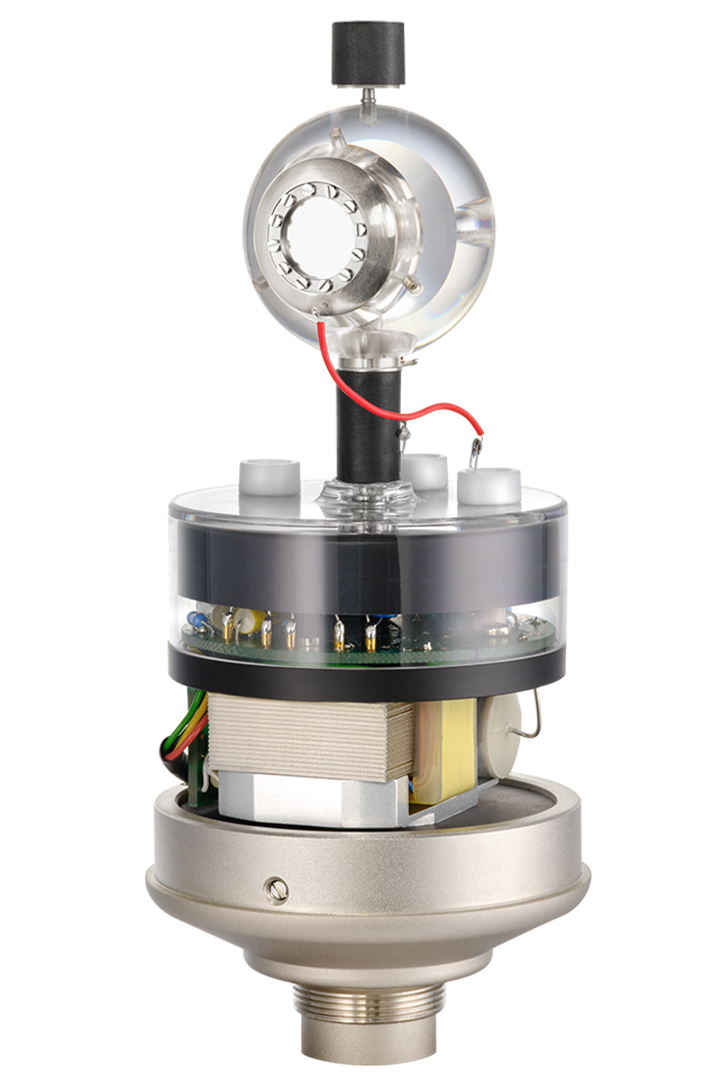
Originally, the engineers used M 49 microphones with their polar patterns adjusted to reproduce the sound space correctly. The technique immediately creates a sense of depth and dimensionality, with extremely accurate capture of the room’s reverberant field. It is particularly useful for classical recording in large reverberant spaces and for multichannel film-music recording. To improve the technique with a microphone designed specifically for the task, Neumann created the M 50.
Despite appearances, the M 50 is not a large-diaphragm microphone. It contains a small 22 mm capsule mounted at the center of a 40 mm sphere. In the low and low-mid frequencies, the microphone behaves as a true omnidirectional, delivering the exceptionally deep and natural response associated with omni microphones. At high frequencies, above roughly 4 to 5 kHz, the diffraction sphere becomes an acoustic obstacle and progressively changes the directivity. At the 8.5 kHz transition point, the microphone becomes almost cardioid, sharpening the geometry of the array. This progressive behavior allows the soundstage to be described in three dimensions with remarkable precision. Finally, a high-frequency pre-emphasis helps compensate for HF attenuation over distance.
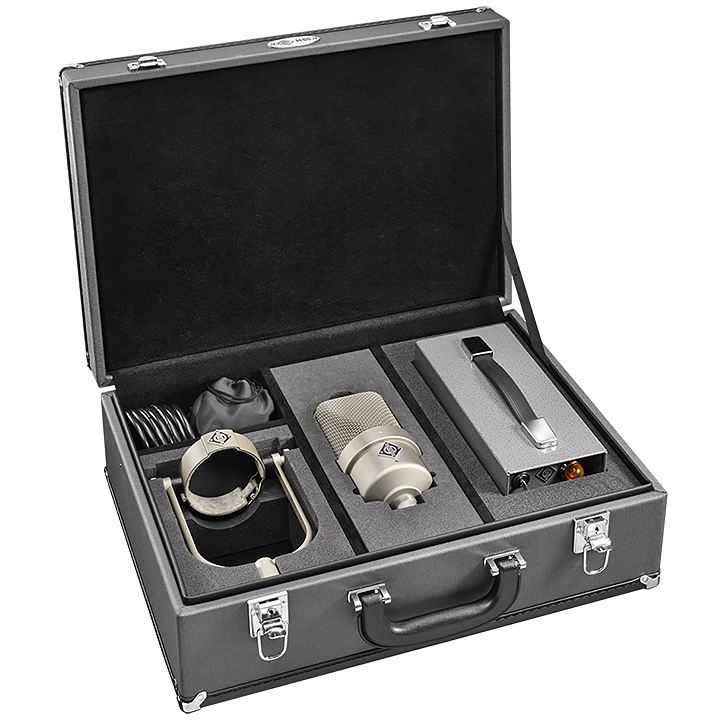
The M 50 V reissue uses the same circuit as the M 49 V, with improved noise and dynamic-range performance. Its AC701k tube has been replaced by the new miniature tube. It incorporates the latest-generation K 33 Ti capsule, with an ultra-thin titanium metal diaphragm for exceptional transient response, along with improved long-term and thermal stability. With this reissue, Neumann enables engineers to return to this recording technique.
Early tests confirm the same behavior and acoustic signature as vintage models, with the benefit of an extremely low noise floor. The financial aspect also matters: it is now possible to buy three new, perfectly matched microphones for a consistent Decca Tree, without facing the speculation surrounding used vintage M 50s that had made assembling a matched vintage Decca Tree almost inaccessible.
Neumann’s commitment to supporting microphone users goes further. A dedicated after-sales service for vintage microphones handles historic models, restoring both relatively recent microphones and very old pieces. The team has the expertise to service them comprehensively, subject to parts availability for extremely old models such as the U 47 or CMV3.
Users can also create an account to register their vintage microphones and serial numbers, an important aid in identifying the legitimate owner of a stolen microphone. Repairs are carried out exclusively with original Neumann parts and, for the oldest models, technicians adjust the microphone to match its historic calibration curve as closely as possible.
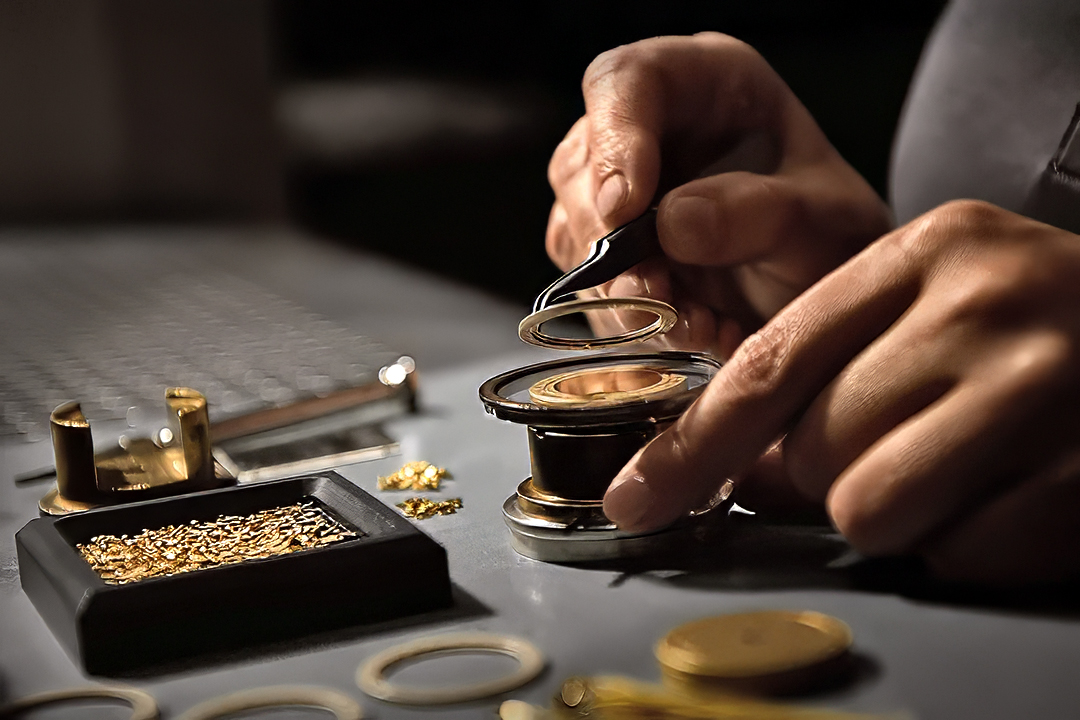
This excellent afternoon in the Neumann environment reveals the brand’s philosophy very clearly: to guarantee a consistent sonic character for the professionals who use its products. Whether we are talking about loudspeakers or microphones, the approach seems the same maintain a clear, high-performance product range and improve what has already worked exceptionally well over time.
Few manufacturers manage to sustain this level of technical excellence, and fewer still preserve it over decades by reproducing their greatest best-sellers almost identically. In short, Neumann’s new monitors and newly reissued microphones place you firmly in the present while keeping you connected to the history of professional audio recording.
For more information on Neumann’s (very extensive) product range