
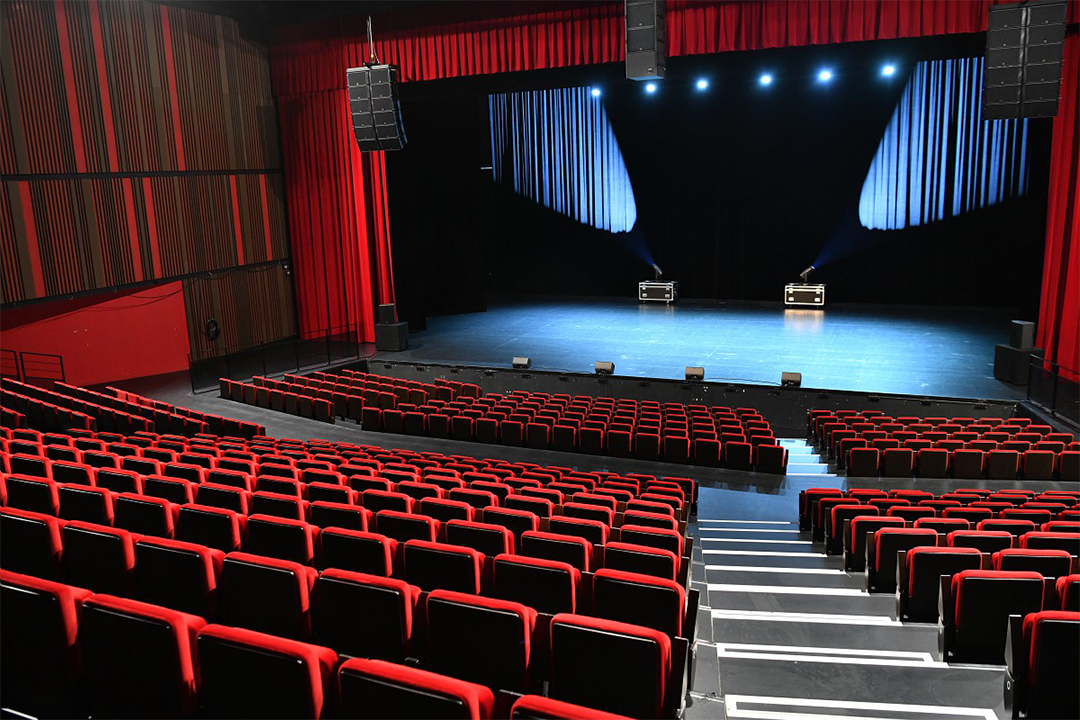
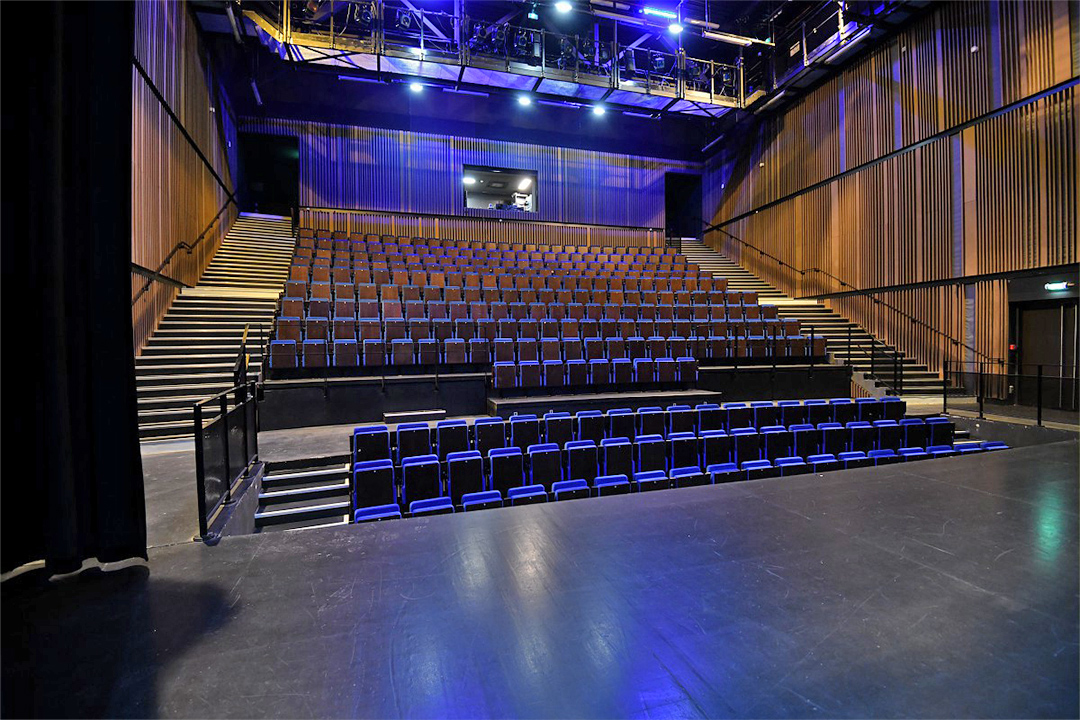
Just steps from Paris La Défense in the heart of Greater Paris, the Courbevoie Event Center is an impressive 5,000-square-meter venue dedicated to events and culture. Two well-appointed performance halls, seating 1,000 and 300, host corporate events and a wide range of shows: theater, comedy, concerts, dance and classical music. The scale of the complex is striking, and the quality of its equipment reflects the audiovisual expertise of its sound manager, Jean-Philippe Edel.
We met him with marketing manager Charlène Lesellier Yver to satisfy our curiosity: inside this multi-venue cultural complex, a new recording facility has been created, Studio Saphir. Naturally, we wanted to find out much more. The venue’s generous volumes are equally impressive, and its technical standard makes clear that audiovisual production is a core part of the operation rather than an afterthought.
SLU : To begin with, can you explain what CourbevoiEvent is?
Charlène Lesellier Yver : CourbevoiEvent is a local public company whose principal shareholder is the Courbevoie town hall. We work directly for the municipality, operating all of its cultural venues. Our main role is to run and animate these spaces through corporate events, artistic programming and cinema.
SLU : Which venues and performance spaces do you manage daily?
Charlène Lesellier Yver : We mainly operate three cultural and event hubs. Espace Carpeaux is Courbevoie’s historic theater, a modern building from the 1990s that has been fully renovated. It includes a 500-seat theater and a very active jazz club. We also operate the Abel Gance cinema, a single-screen arthouse theater. Finally, there is the Event Center, the modern 2014 building where we are today, with a 1,000-seat hall, a 300-seat room and several modular reception areas.
SLU : There is also a strong concentration of cultural and sports facilities immediately around the site, almost like a miniature La Villette.
Charlène Lesellier Yver : It is a true integrated cultural hub developed by the city. At Espace Carpeaux, for example, we share the building with the Courbevoie music conservatory, which has classrooms and its own auditorium. The sports complexes and stadium are also next door, creating a great synergy among the city’s different audiences.
SLU : And now it also has a recording studio?
Jean-Philippe Edel : The space was designed from the outset as a music studio. In its first form, however, it was mainly a rehearsal room for musicians and small local bands, available by the hour at a very low rate. There was one rehearsal room and a small, very basic adjacent control booth with analog equipment, a few monitors and a simple recording system.
Charlène Lesellier Yver : The original idea was to offer a complete environment for music creation and recording, directly connected with our artistic seasons. But the studio did not yet have the acoustics or equipment level required to attract professional users.
SLU : …with the distinctive goal of being designed for immersive audio?
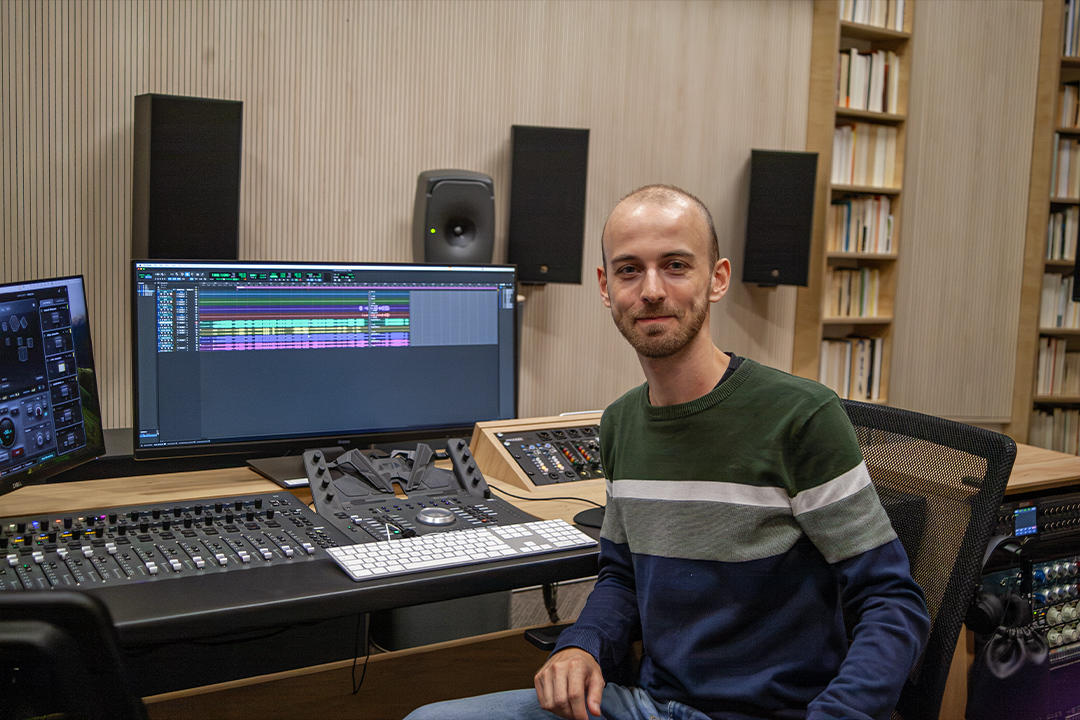
Jean-Philippe Edel : When I arrived in 2023, the previous technical director was about to retire. Before leaving, he gave me a mission: integrate a 5.1 immersive system into the studio. Coming from recording, I found the request quite complex. Immersive studio audio and live sound rely on very different skills, technical profiles and playback logic. I wondered whether one technology could bridge both worlds. During my research I discovered L-Acoustics L-ISA, which offered exactly that possibility.
I spent many nights studying the feasibility of a hybrid project: system architecture, infrastructure, acoustics, playback and staff training. Management eventually approved the project. Implementation stretched over two years of investment, covering acoustic design and treatment, equipment, deployment, cabling and internal training. The goal was an environment that could meet both immersive studio and live-mixing requirements, turning their complementarity into a production tool. The process was therefore not only a question of buying an immersive loudspeaker system, but of building a coherent technical environment in which recording engineers and live-sound teams could work with familiar tools while learning a shared spatial-audio workflow.
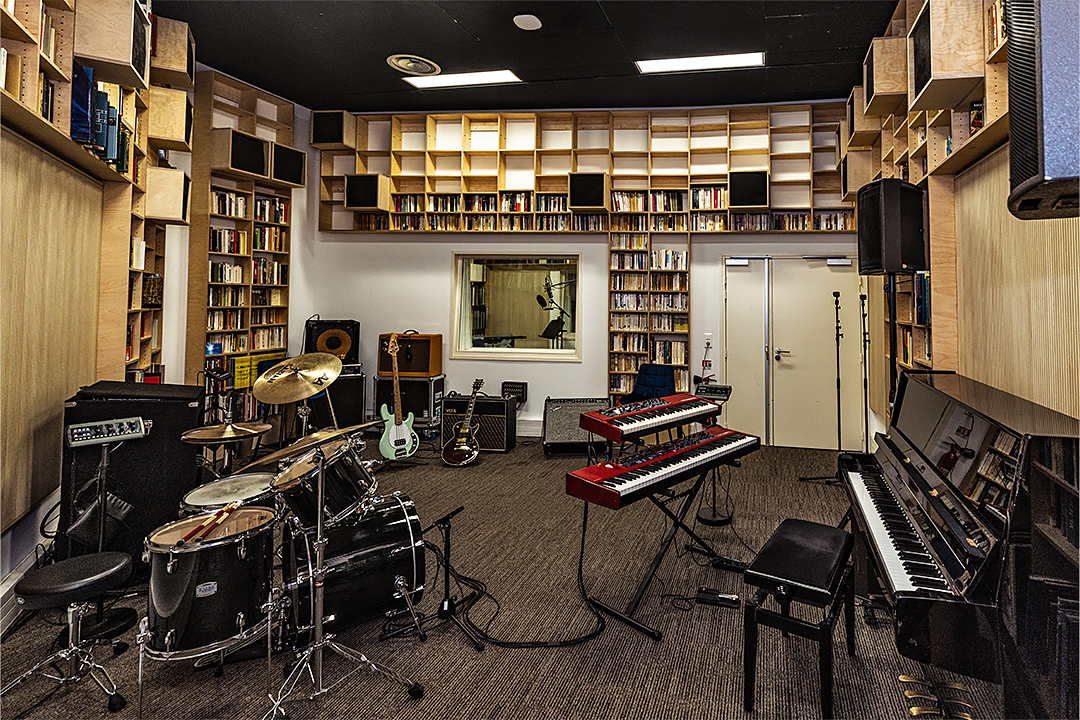
SLU : Let’s describe the space. The studio is divided into three areas, all with visual continuity?
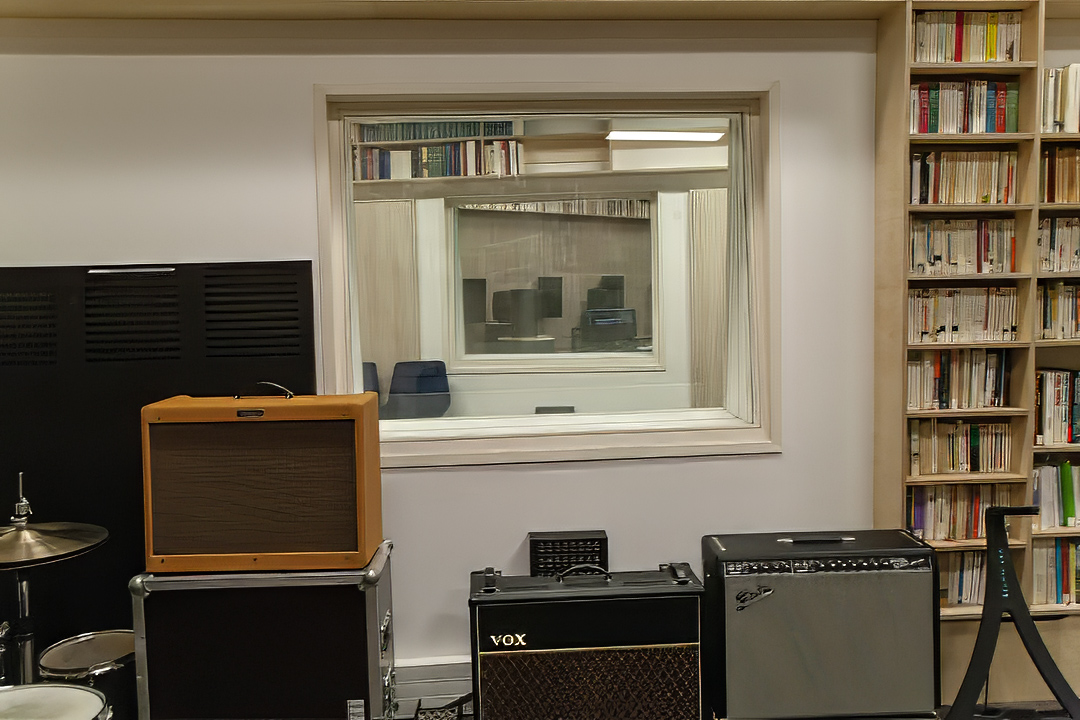
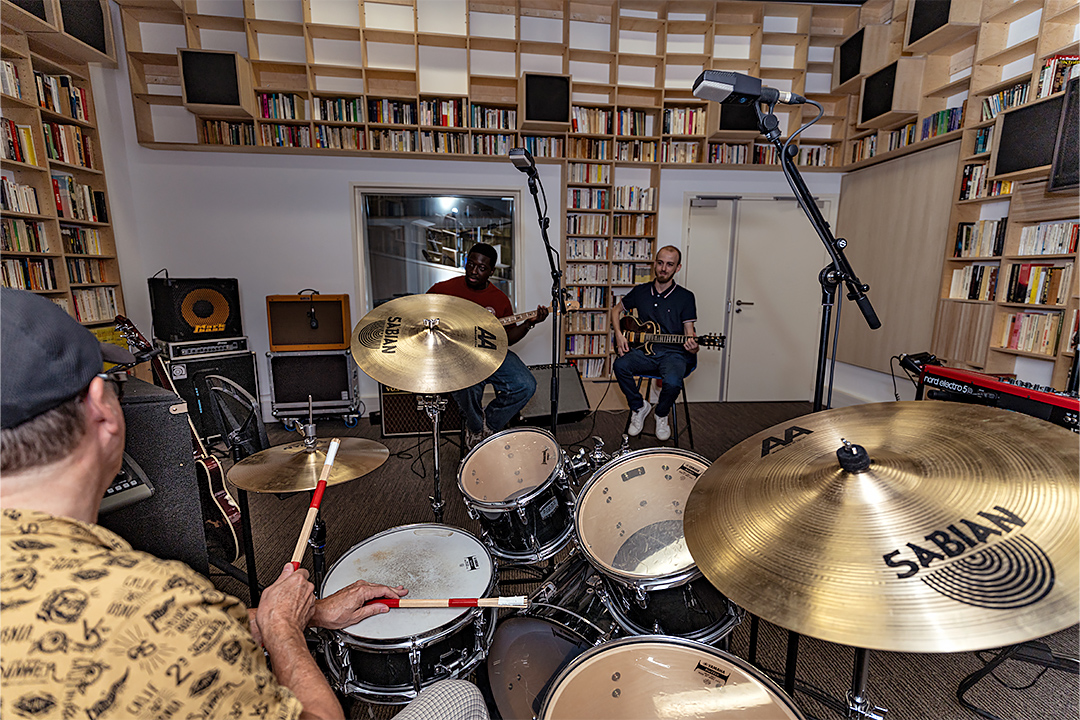
Jean-Philippe Edel : Yes, and that is one of its nicest features. The live room is about 40 square meters, comfortably large enough for a full band. It also has generous ceiling height, which is unusual in a modern recording studio. We provide high-quality backline for artists. Since we also manage the jazz club at Espace Carpeaux, we have an excellent instrument inventory: guitar and bass amps, keyboards, several complete drum kits from major brands and quality snare drums.
SLU : Do musicians benefit from personal monitoring in the studio?
Jean-Philippe Edel : We eliminated complex, time-consuming setups. We use a Behringer P16 system, a fully plug-and-play solution. From Pro Tools we send subgroups or stems — up to 16 independent channels, configurable in stereo if needed — directly to the network. Each musician then builds a personal mix from the P16 controller without interrupting the engineer. Everything is prewired and ready to go.
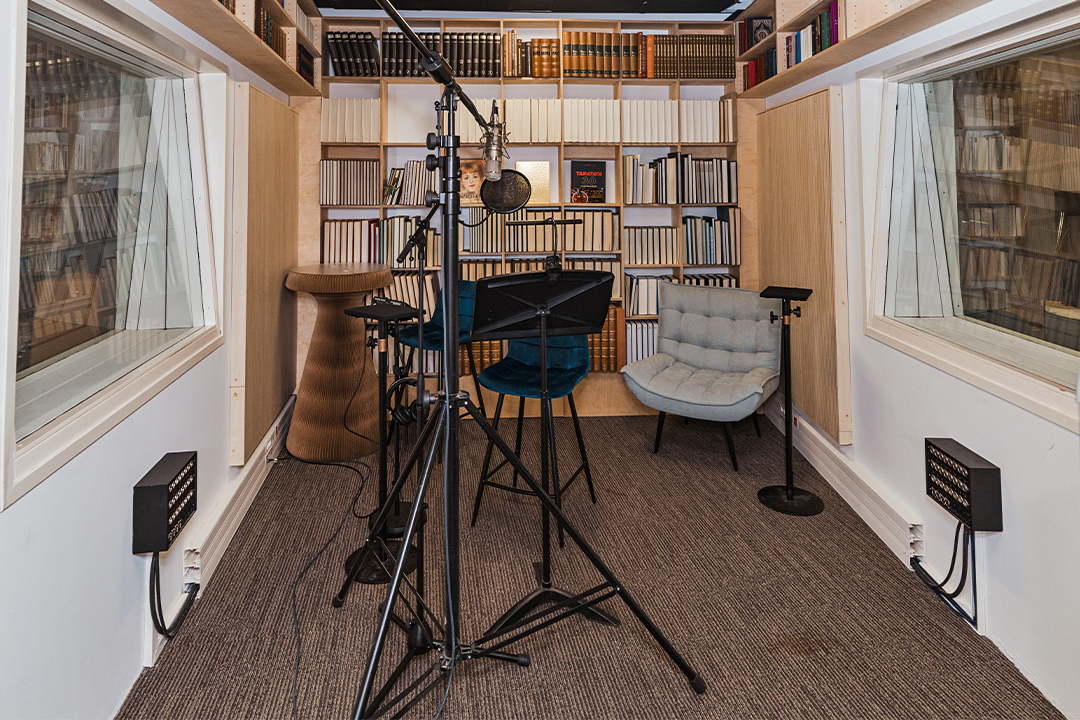
SLU : Let’s move to the second space in the middle: the vocal booth…
Jean-Philippe Edel : It is a warm, comfortable booth with dimmable lighting for relaxed sessions. It has a fully isolated entry vestibule and, most importantly, windows on both sides toward the live room and control room. The artist can see the engineer on one side and the other musicians on the other, which is essential for comfort and musical interaction. It is designed for very dry vocal recordings, but its acoustic versatility also makes it useful for an isolated, punchy drum kit or acoustic guitar.
SLU : What about the control room, with its particular choices in furniture and ergonomics?
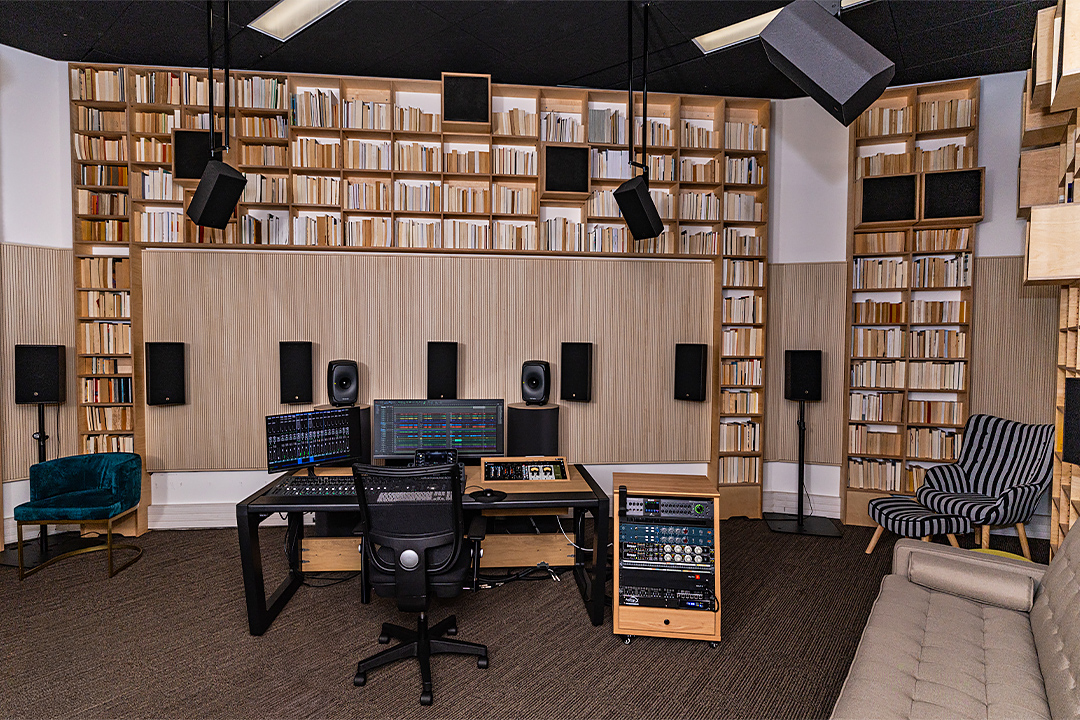
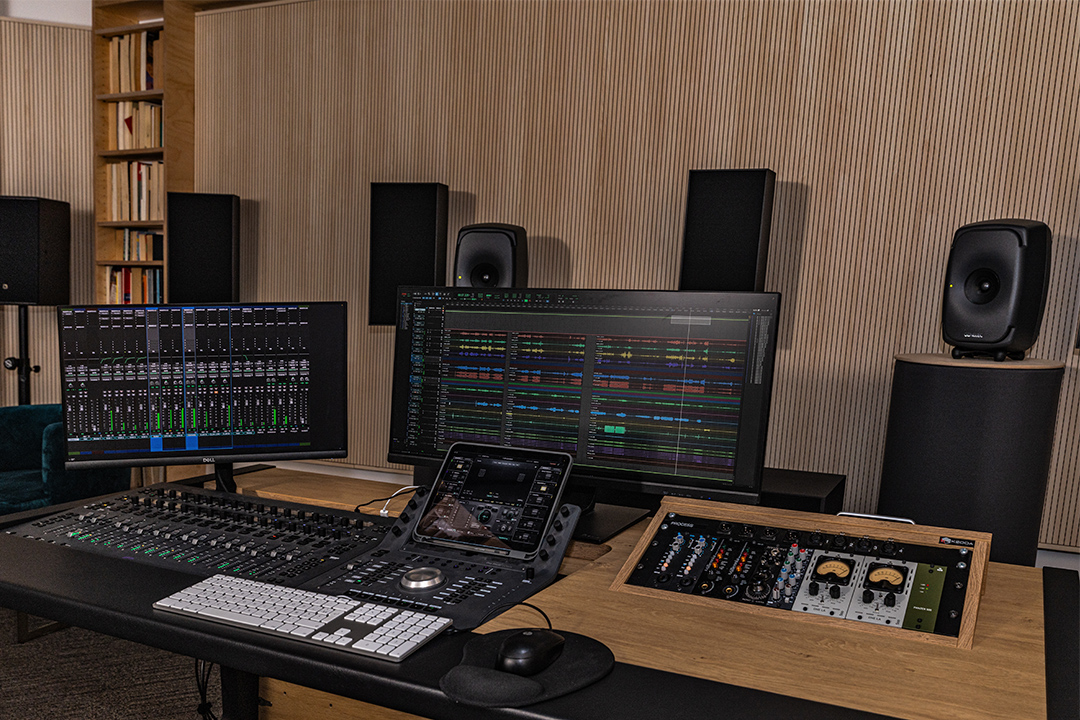
Jean-Philippe Edel : The control room is the heart of the studio and was designed to be highly modular. All furniture is on casters. The main workstation, built by specialist manufacturer Keoda, integrates an Avid S3 control surface and Avid Dock. A small 500-series rack can also be moved freely. The same applies to the adjacent analog outboard rack, which can sit to the left or right of the console. The cabling was designed for this flexibility. Nothing is fixed except the monitoring system, to preserve the angles required by the immersive layout. Floor marks allow the furniture to be returned to the optimum listening position.
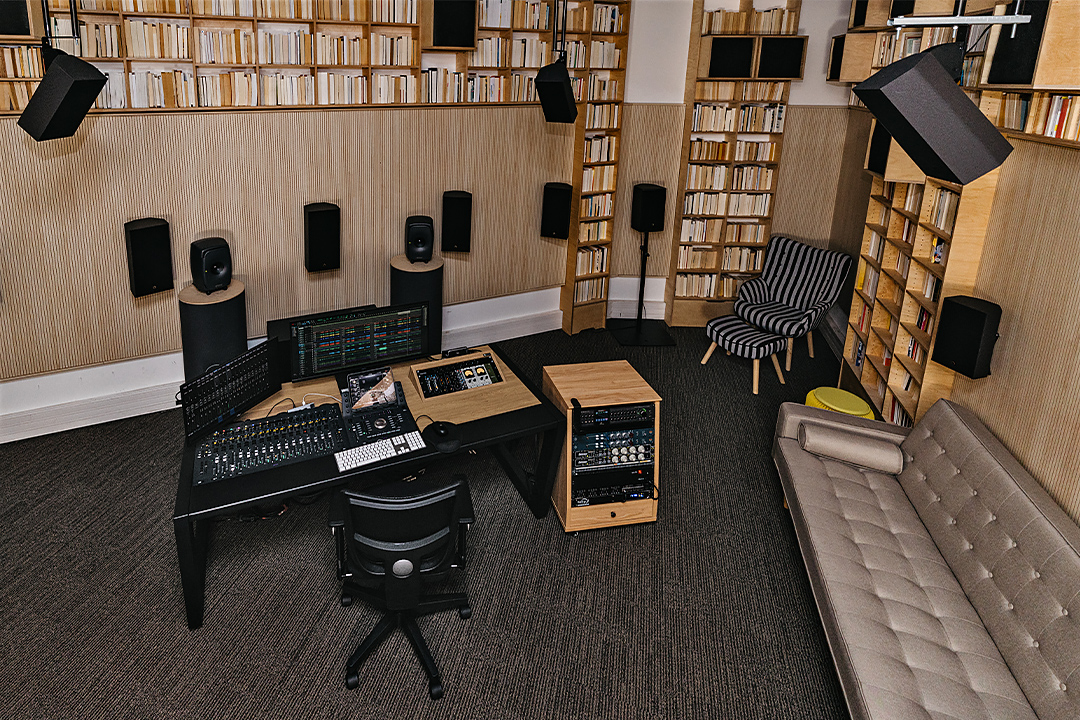
SLU : This furniture draws on the layouts of internationally renowned studios. Can you tell us more?
Jean-Philippe Edel : I was strongly inspired by the UK studio Such Sweet Thunder and its experienced engineers Peter Cobbin and Kirsty Whalley, who developed the ergonomic Thunder Desk. It integrates controllers, screens and monitoring beautifully. Working at a desk with this level of aesthetics and ergonomics immediately makes you want to create; it gives the room character and moves away from the cold gray control rooms we often see. Having also spent three years as an assistant at Guillaume Tell, I wanted another comfort feature that matters to me: a wide console armrest. It may sound minor, but during long, demanding sessions, being able to lean on a real armrest changes the engineer’s experience.
SLU : I assume the studio is connected to the rest of the complex?
Jean-Philippe Edel : Yes. Within this 5,000-square-meter ecosystem for events, live performance and artistic creation, Studio Saphir connects directly to the site’s other spaces over an OM3 fiber audio/video network. The architecture is fully Dante-based.
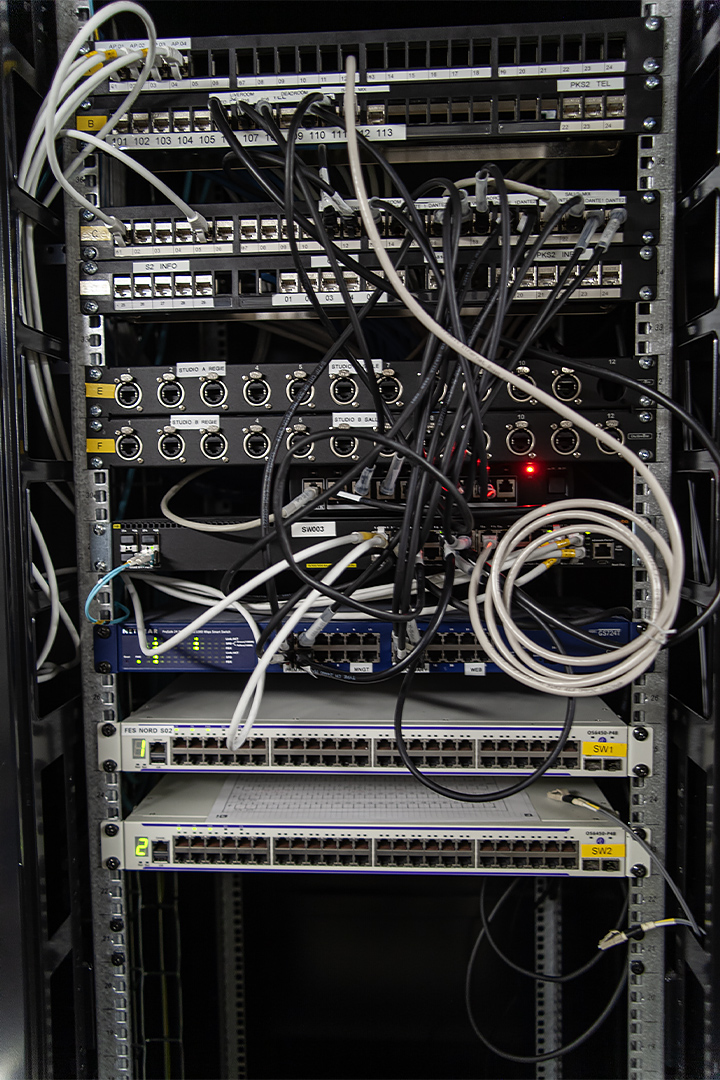
A technical room behind the control room houses the main patching rack. All CourbevoiEvent performance spaces — the 1,000-seat hall, the 500-seat theater and reception areas — are linked by fiber to this rack through Aruba 2930M and 2540-24G switches; we are moving to Netgear AV M4350-16M4V switches. In the studio, each wall in all three rooms has three RJ45 network outlets returning to the main rack. I can create VLANs on demand to isolate Dante or video traffic, build very high-bandwidth fiber paths and manage the proprietary Behringer P16 musician-monitoring signals.
Everything can be separated or interconnected instantly. This makes it possible to record a concert or show, capture live content during an event, or handle live broadcasts. In practice, this means the studio can operate as an isolated production room or as an extension of any of the connected venues, with audio, control and video resources routed according to the requirements of each production.
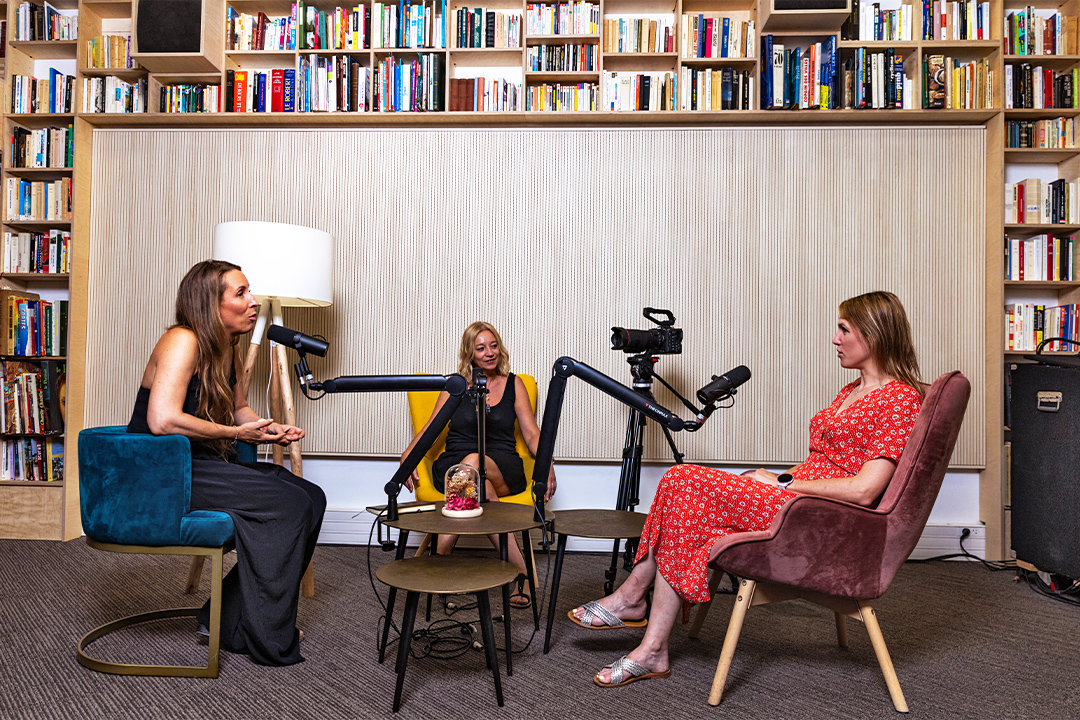
SLU : One of the biggest surprises when entering the studio is its acoustics, especially the unique design using thousands of books.
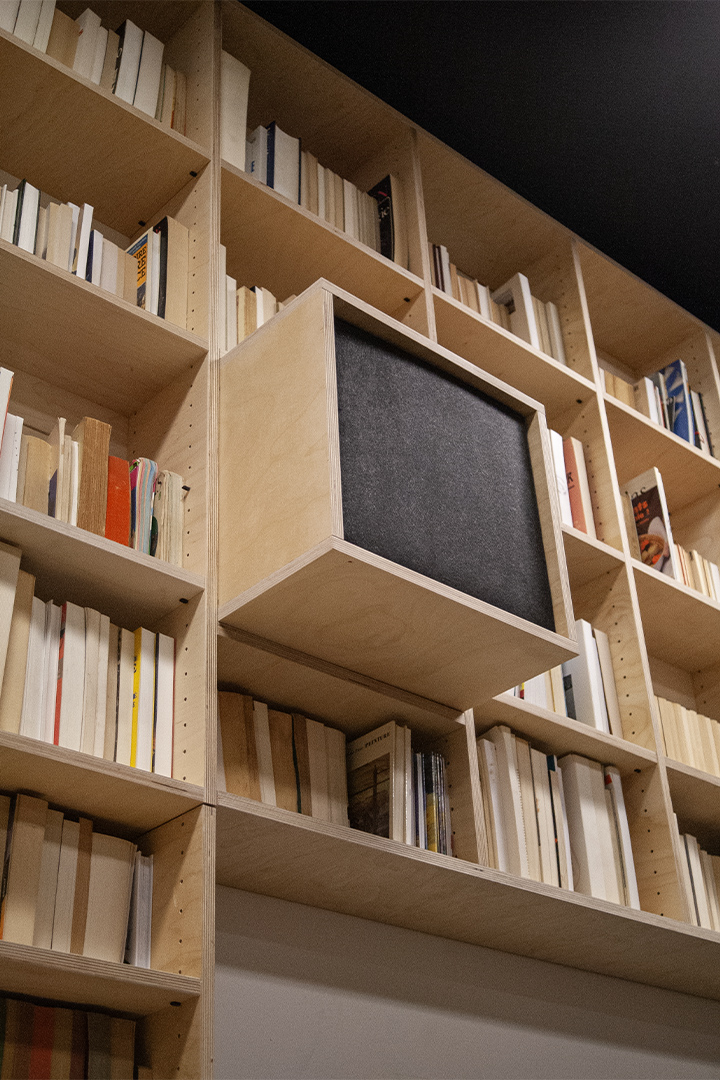
Jean-Philippe Edel : Acoustics were entrusted to external acoustician Antoine Hurtado, vice-president of AES France. The main constraint was to create a highly cost-effective treatment for large volumes while giving the space a genuine visual and human identity. That led to the idea of using thousands of books of different sizes in custom plywood shelving.
SLU : What is the real physical and acoustic effect of all those books?
Jean-Philippe Edel : It is simply an excellent acoustic idea. Because of their varied formats, paper thicknesses and irregular placement, the books act as very effective diffusers. They break up hard high-frequency reflections efficiently without deadening the room. The result is a controlled, warm room sound that remains lively and balanced. They also add a cultural, poetic and human dimension. Artists need to feel inspired and forget cold technology; this mass of books creates a welcoming atmosphere that supports creativity.
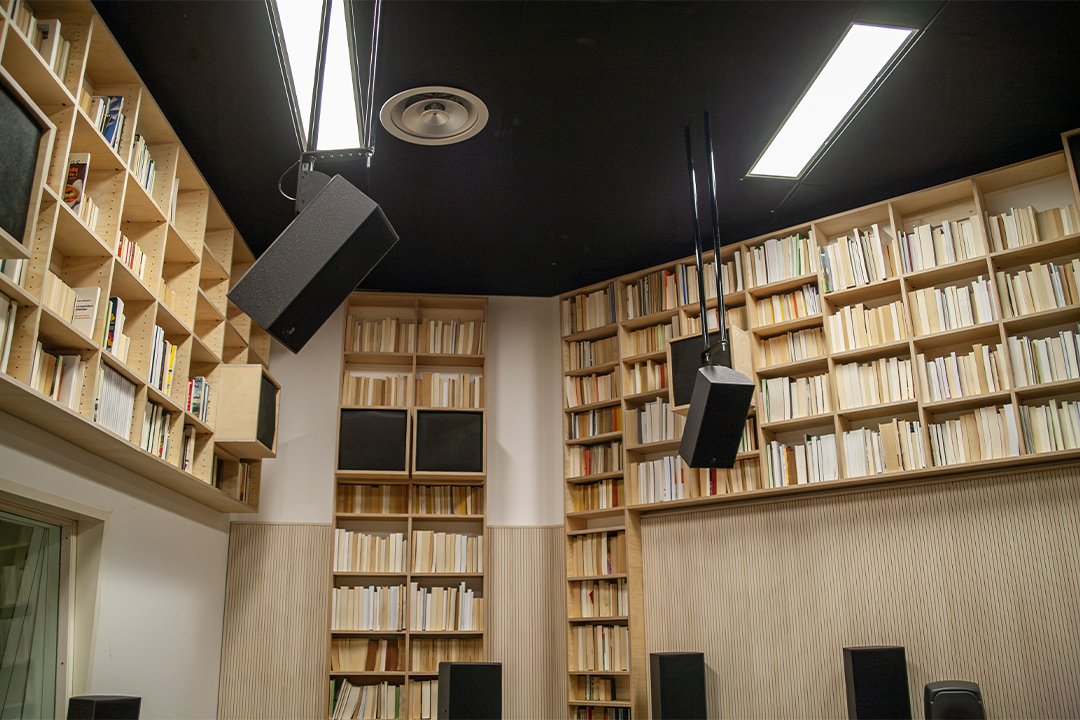
SLU : How did you manage to collect so many books?
Charlène Lesellier Yver : It became a wonderful community project lasting nearly two years. We appealed for donations through our audience and subscriber databases, and people responded enthusiastically. City libraries also supplied many books removed from their collections. We recovered the entire personal library of one of our technicians when he moved, then completed the stock with large lots bought for a few euros on second-hand sites. It was painstaking work, but the result is spectacular.
SLU : What other acoustic treatment was implemented?
Jean-Philippe Édel : Antoine Hurtado carried out very precise acoustic measurements before and after the work, including rigorous decay-time plots. To address mid and low frequencies, we installed resonators on the walls: wooden frames filled with specific mineral material, covered in acoustic fabric and mounted with a calculated air gap from the wall. This controls resonances and standing waves. The ceiling uses a stretched acoustic membrane with a one-meter air cavity and absorption similar to the wall treatment. The result is a remarkably even frequency response with no troublesome resonant modes in the listening area.
SLU : And I assume the studio is isolated from the performance halls?
Jean-Philippe Édel : The isolation is excellent. We tested the adjacent venue systems at maximum SPL and heard absolutely nothing in the studio control room.
SLU : Let’s move to the core technical section and the monitoring system. How is the loudspeaker infrastructure organized?
Jean-Philippe Edel : We chose a high-end system based on L-ISA recommendations. The immersive front consists of five X8i coaxial speakers, which extend down to 40 Hz, the lower limit required for proper immersive calibration. For side surrounds and the ceiling we use eight X6i, more compact but with the same coaxial technology for consistent timbre. Two L-Acoustics Syva Subs handle LFE. The immersive system is powered by an LA7.16i multichannel amplified controller plus an LA2Xi for the outer front speakers. They sit in the control room because they produce no fan noise. A pair of Genelec 8341A coaxial monitors provides nearfield stereo listening.
SLU : I don’t see an L-ISA processor?
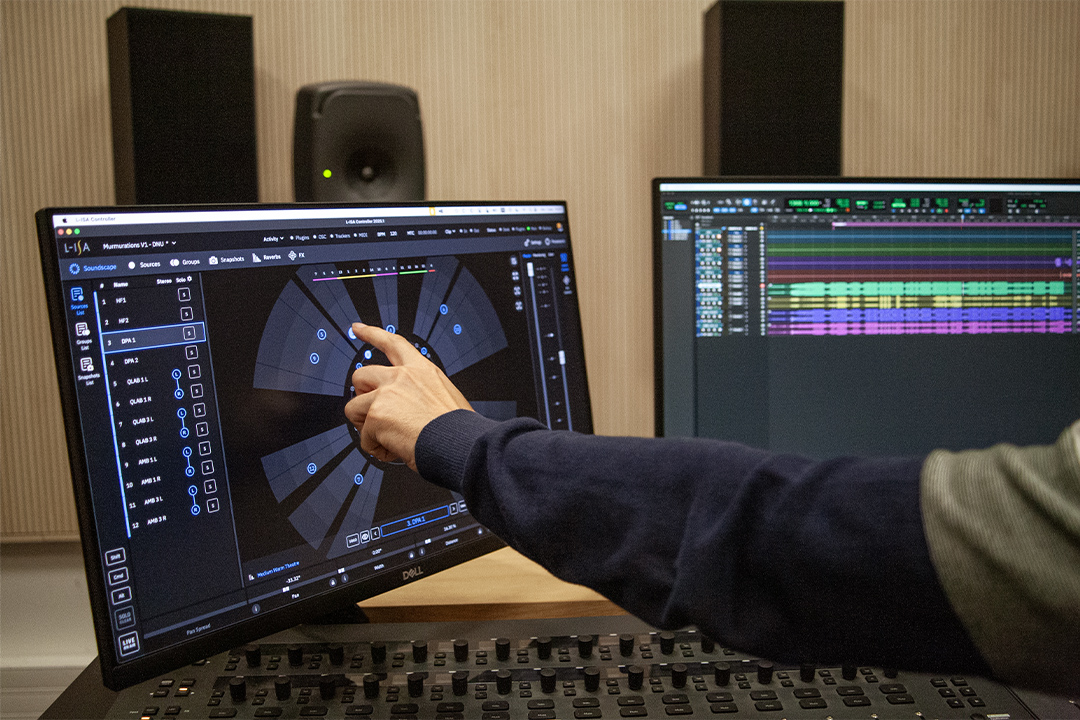
Jean-Philippe Edel : We do not use the hardware L-ISA processor for object mixing. Instead we run the native L-ISA software, which handles 96 objects across 16 output channels — ideal for our monitoring configuration.
SLU : With this software solution, what workflow do you use for object-based mixing?
Jean-Philippe Edel : In Pro Tools, audio tracks are routed to L-ISA through L-ISA Audio Bridge or aux sends. A plug-in in Pro Tools directly controls the position and movement of virtual objects in L-ISA Controller. I prefer spatial positioning in L-ISA because its presets and interface are much faster and more intuitive than Dolby Atmos’s native panner. If needed, the L-ISA-processed channels are sent to the Dolby Renderer to record and export the final ADM master required by streaming platforms such as Apple Music. Here, Pro Tools essentially acts as the player/recorder. It still amazes me how much production power fits into a single Mac Studio.
SLU : Which immersive formats do you offer?
Jean-Philippe Edel : We can switch instantly between two immersive monitoring configurations. One is L-ISA 11.1.4, using the complete five-X8i front system at the stage angles recommended by L-Acoustics — essentially a linear stage-front playback system. The second is Dolby Atmos in 9.1.4 or 7.1.4. In Dolby object-mixing mode, we disable the two outer L-ISA front speakers and retain the three central left/center/right speakers required by Dolby, along with surrounds and four overhead channels.
SLU : Your Pro Tools workstation uses an Antelope Goliath audio interface. Is it well suited to this setup?
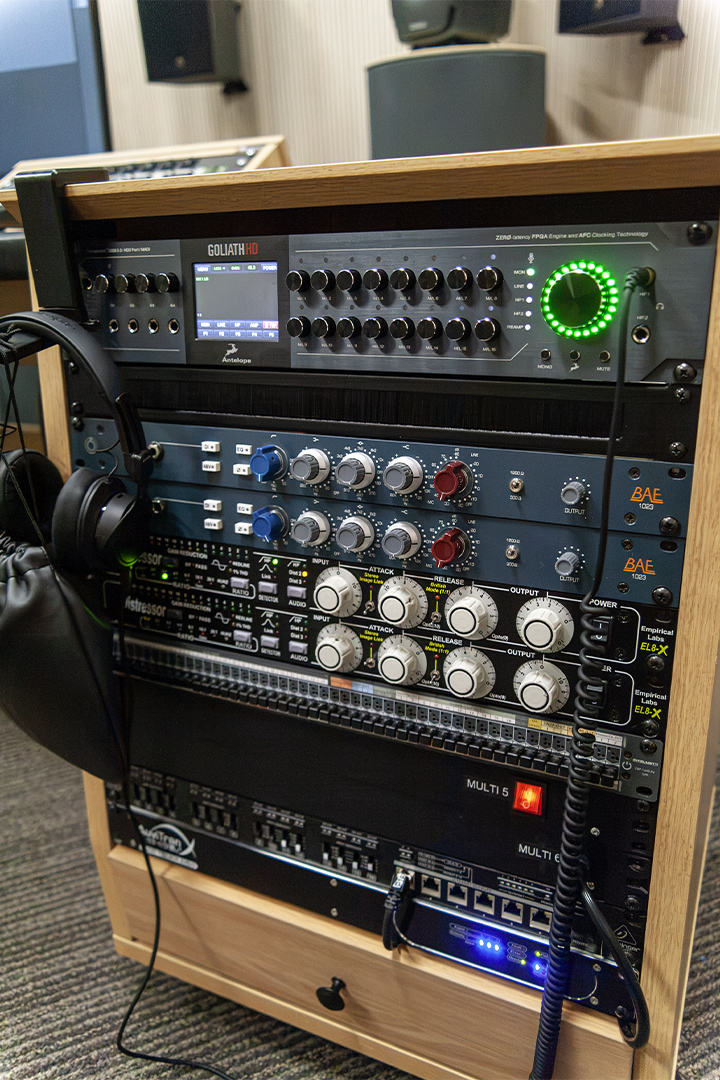
Jean-Philippe Edel : The Goliath was purchased long before the immersive project. It is an excellent interface, with outstanding internal analog routing and 16 high-quality preamps, but its digital outputs are MADI or ADAT only — no native Dante or AVB. Yet the L-ISA processing environment operates over AVB, while all connections to our performance halls use Dante.
SLU : What solution did you find to combine MADI, Dante and AVB?
Jean-Philippe Edel : We use an AuviTran AVBx3 converter as a universal bridge. We leave the Antelope Goliath over MADI, and the AuviTran converts the signal to Dante for the other halls and to AVB for direct connection to the L-Acoustics amplified controllers. It may look complex on paper, but once configured it is extremely stable and transparent. We mainly work at 48 kHz for immersive projects, the standard required for Dolby Atmos and Apple Music.
SLU : Managing all these monitoring systems must be complex. Do you use a dedicated monitor controller?
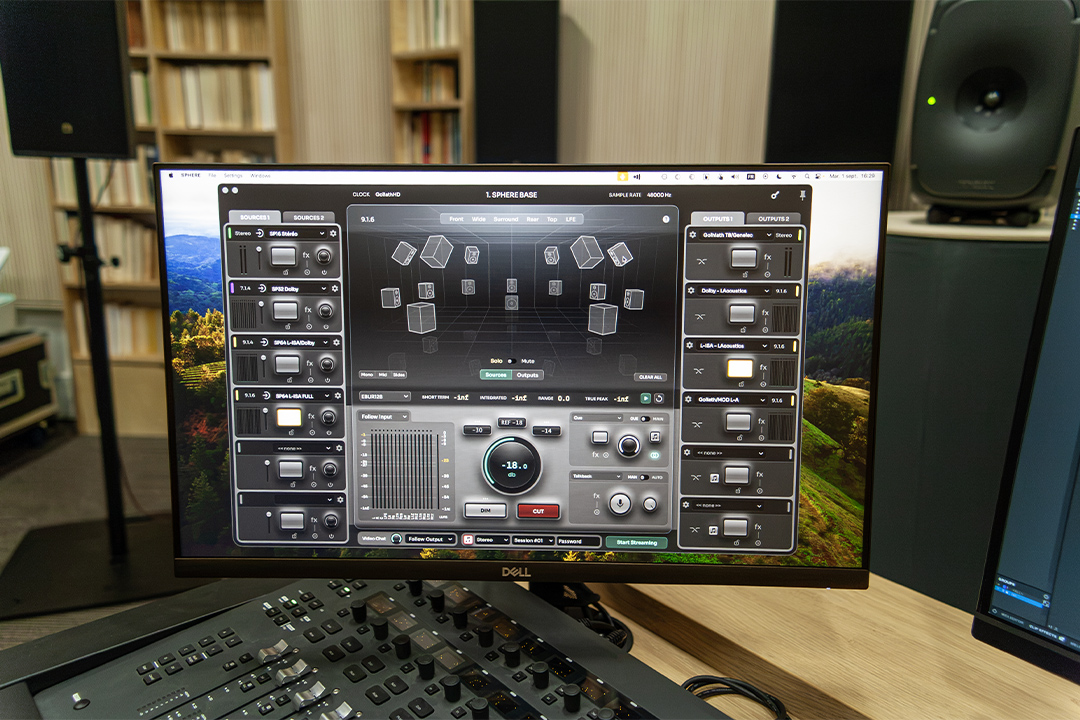
Jean-Philippe Edel : I found the solution in Ginger Audio’s Sphere software. Without it, multichannel monitoring in a hybrid configuration like ours would be a technical nightmare. Sphere runs as standalone software on our Mac Studio M2 Pro and can be controlled physically from the Avid S3 and Avid Dock. It acts as a virtual audio interface for the Mac. In Pro Tools, our master buses do not feed the Goliath directly; they all go into Sphere, which then routes them transparently to the Goliath’s physical outputs or the loudspeaker network.
SLU : What practical monitoring functions does Sphere provide?
Jean-Philippe Edel : The software includes predefined multichannel I/O formats and supports several input sources. We can monitor the Pro Tools multitrack output or switch to a Dolby Atmos track playing from Apple Music. With one click on the touchscreen or Avid Dock, Sphere remaps its outputs to the Genelecs or to whichever immersive system we choose, L-ISA or Atmos. It also provides precise bass-management filters.
We can apply phase rotation, millisecond-level delays or insert any third-party corrective EQ or calibration plug-in on a specific channel. For mixing comfort, Sphere also creates mute or solo groups from the touchscreen, so we can hear only the ceiling speakers, rear surrounds or front array. The objective is to make changes between stereo and immersive listening as immediate as possible, without forcing the engineer to rebuild routing or calibration each time a different format or source must be checked.
SLU : Ginger Audio also offers integrated tools for remote work with clients. Do you use them?
Jean-Philippe Edel : Yes, and it is a major commercial advantage. Sphere lets us stream the studio mix live over the internet, whether stereo or immersive binaural. A client — a producer in Paris or abroad — simply connects through a web page or dedicated app on a computer or phone. They can hear the Pro Tools session in real time at high quality, join a video chat and give immediate feedback.
SLU : What about recording? I understand you have an exceptional microphone collection…
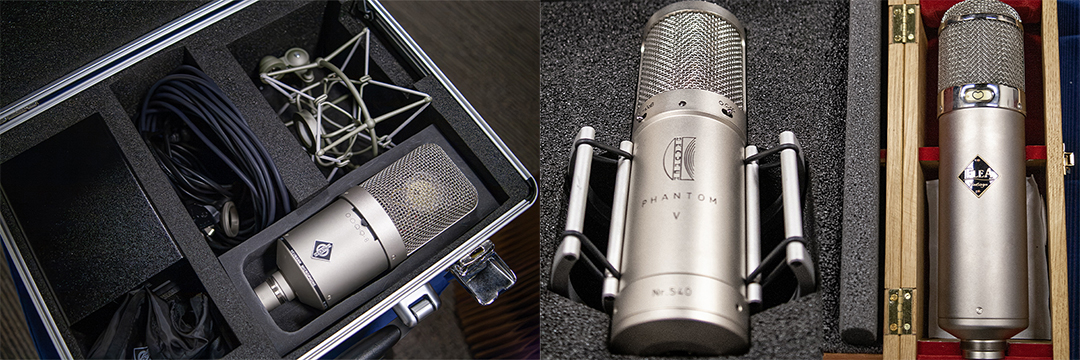
Jean-Philippe Edel : Our ‘magic cabinet’ really does contain some beautiful pieces. The collection was carefully assembled before I arrived by Fabien Aumeunier and Alexandre Chaigne, two highly experienced professionals. The centerpiece is a Neumann M149 Tube. We also have a superb Flea 47, a high-end tube recreation of the legendary Neumann U47, plus two Brauner Phantom-Vs. There are also more distinctive microphones, including Ear Trumpet Labs models.
SLU : What about ribbon microphones and their particular sonic character?
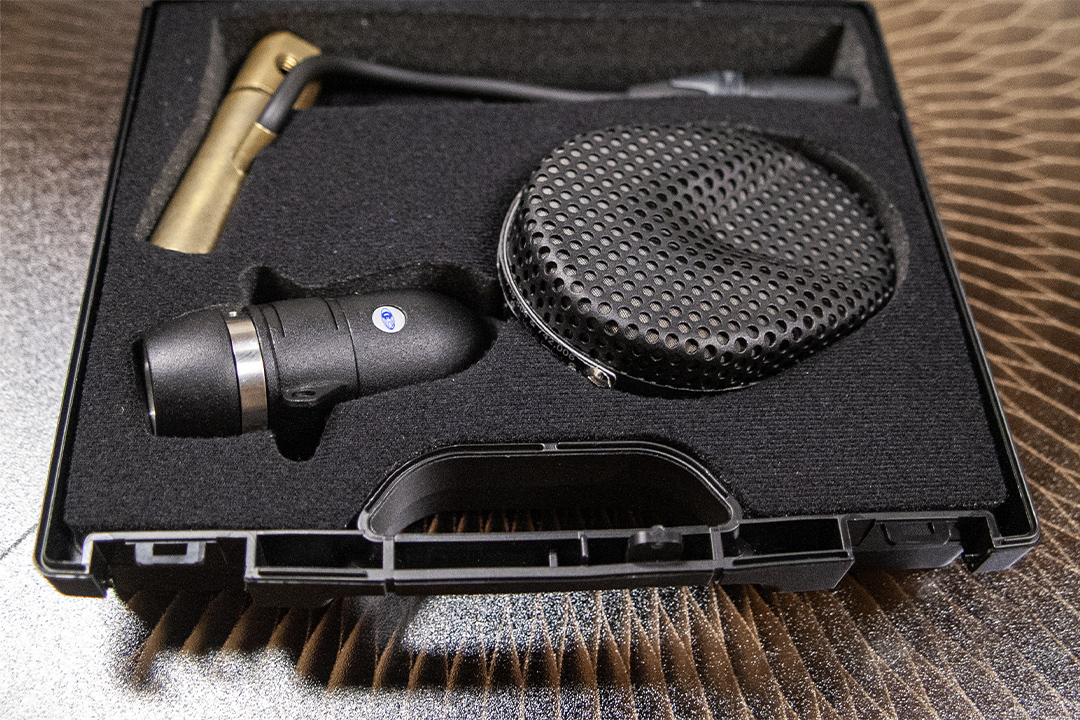
Jean-Philippe Edel : We are fortunate to own a pair of Coles 4038s. They are absolute classics with an instantly recognizable sound, offering great smoothness and harmonic depth without harsh highs. We use them frequently as drum overheads or room mics, or alongside other microphones to add space and texture.
SLU : And of course you have more conventional models as well?
Jean-Philippe Edel : We have many Neumann condensers, including the KM series, along with sought-after vintage dynamics such as Sennheiser 421s. We also have DPA 4099s for close miking, the essential Shure SM7B for narration, and other familiar Shure models for stage use or electric instruments. Because we can also draw on the microphone inventory from our concert halls, we have enormous flexibility and a broad palette of capture options.
SLU : All those microphones deserve excellent mic preamps?
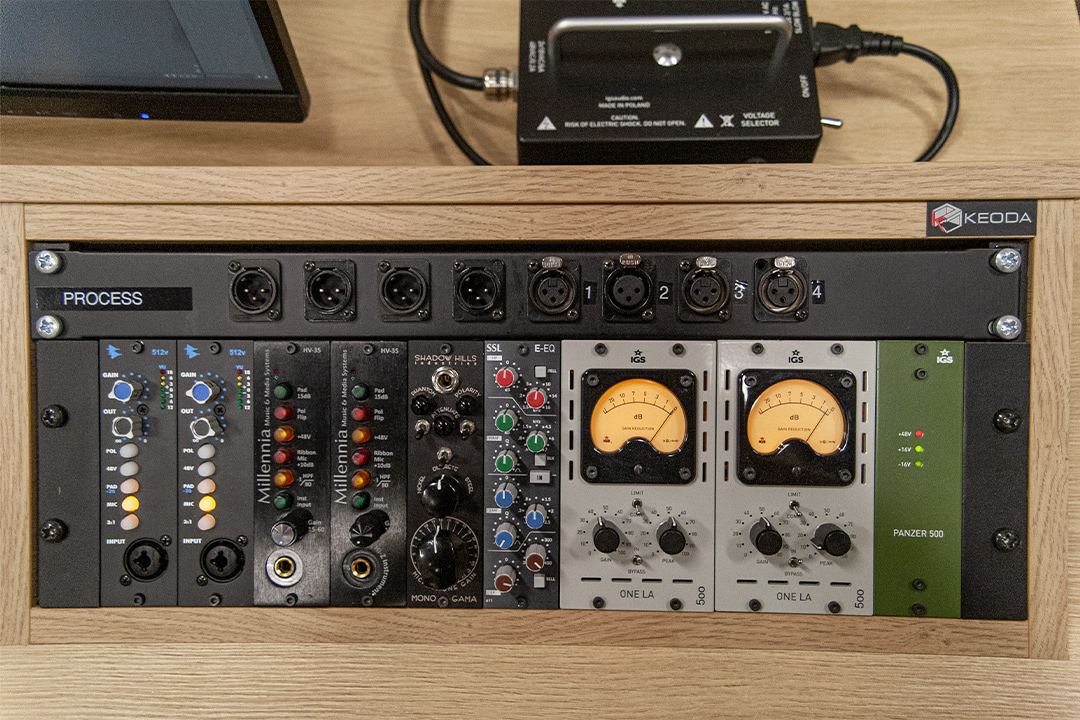
Jean-Philippe Edel : Although the Antelope interface preamps are excellent, we still like to offer different colors and behaviors depending on musical style and source. For that we have API, Millennia, Shadow Hills and Neve preamps, plus SSL EQ and an IGS ONE LA compressor.
SLU : How do you explain the differences in philosophy and calibration between Dolby Atmos and L-Acoustics L-ISA, which coexist in the studio?
Jean-Philippe Edel : It is a fascinating question. The two systems take very different approaches to acoustic space. Dolby Atmos is designed around a single listening point, the studio sweet spot. To calibrate an Atmos room, we precisely measure the distance from every speaker to the listener’s ears at the center and apply fine delays so the wavefronts arrive in phase at that point. L-ISA, by contrast, comes from live sound. Its philosophy is not to target one point but to cover a much wider listening area, with each loudspeaker reproducing the source of the audio object within the room.
SLU : How does that difference translate in practical monitor calibration?
Jean-Philippe Edel : With L-ISA, we apply no loudspeaker delay during calibration. The priority is for every speaker to have the same frequency linearity and SPL. L-ISA itself handles object spatialization. That can be mentally challenging for engineers accustomed to traditional stereo or Dolby workflows. To switch between worlds, we load the appropriate calibration profile — Dolby Atmos or L-ISA. All calibration is performed in the DSP of the L-Acoustics amplified controllers.
SLU : Studio Saphir is an impressive creative tool. What is CourbevoiEvent’s commercial strategy for this infrastructure?
Charlène Lesellier Yver : We are entering an active marketing and promotion phase. Our first objective is to capitalize on our internal artistic synergies. We host many companies and artists in creative residencies throughout the year. An artist performing in our large hall can leave with a complete multitrack recording or a mix of the show, which is a highly attractive offer. The studio is also open now to outside projects for recording, mixing in any field and immersive-show preproduction.
SLU : What other types of clients or partnerships are you targeting beyond resident artists?
Charlène Lesellier Yver : Communications agencies and companies producing audio content such as corporate podcasts, voiceovers, interviews or trailers. We also want to build close academic partnerships with sound schools and audiovisual universities. When the studio is less busy, we want students to use this remarkable facility to practice immersive audio, object-based mixing and calibration techniques.
Jean-Philippe Edel : The technical possibilities are vast. With our fiber network and Sphere, we are ready to provide high-quality live immersive or stereo audio streaming to broadcast networks and distribution platforms. Immersive audio is no longer distant or prohibitively expensive; it has become democratized and is now part of everyday listening. We are proud to be among the few French cultural and event complexes equipped with such a tool, and we look forward to welcoming our first artistic projects and bringing this unique space to life.
With a smart approach, well-mastered equipment and a forward-looking concept in a highly enjoyable creative setting, CourbevoiEvent’s Studio Saphir illustrates the direction of a new generation of recording studios. The once separate worlds of live sound and studio production now meet in configurations where technologies and working methods overlap. We are entering the era of the hybrid studio, moving from live to studio and back again or combining both to develop the increasingly common immersive productions used in live entertainment. The project is also a good illustration of how networked audio, software-based monitoring and object-based mixing are progressively erasing the traditional boundary between recording, post-production, broadcast and live performance.
More information:
Studio Saphir – CourbevoiEvent – 7 boulevard Aristide Briand à Courbevoie
Contact : [email protected] – www.courbevoievent.com