
Of all the production studios at the Maison de la Radio, Studio 105 is considered the flagship. Inseparable from Radio France’s major live broadcasts, including the famous Black Sessions, it has hosted some of the biggest names on the French and international music scenes.
In December 2018, it was Studio 105’s turn to enter the renovation program covering all the studios, the culmination of many years of thinking about how to transform the traditional radio studio into a genuine live performance and multimedia creation space capable of meeting the new challenges of radio production today and tomorrow.
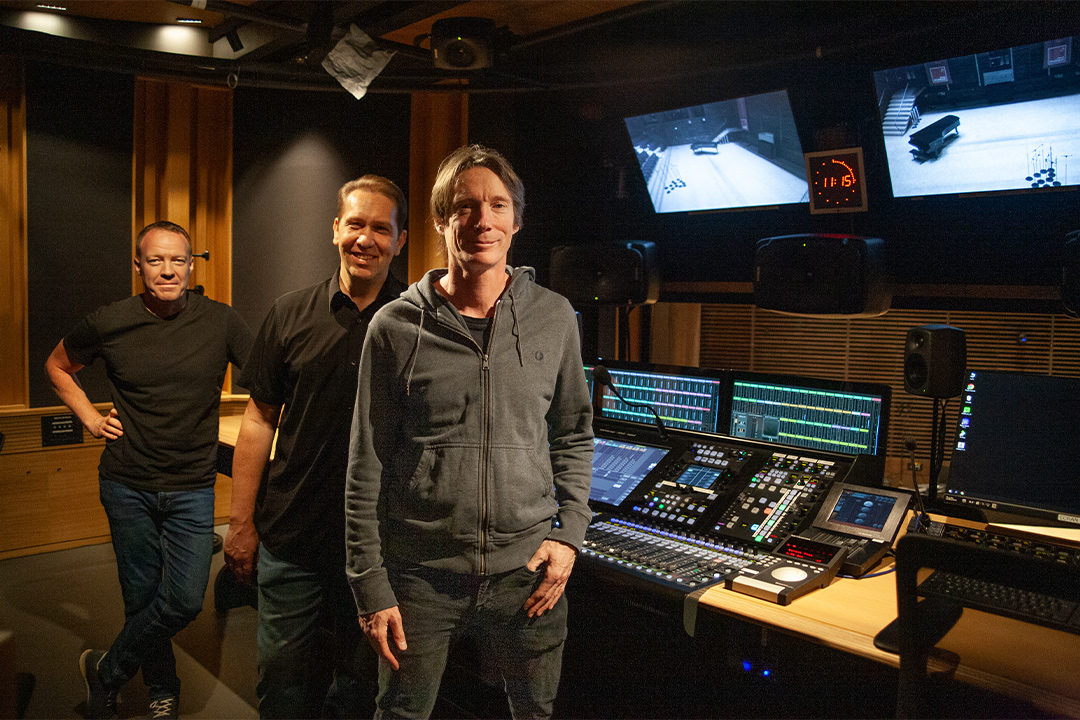
Its reopening a few months ago marks a major step in the modernization of Radio France’s facilities, combining a unique acoustic heritage with the latest technologies in sound spatialization, object-based mixing and networking. Fully immersed in this new environment, we met Philip Merscher, Technical Manager for Audiovisual Production, Jean-Benoît Têtu, Sound Reinforcement Engineer, and Guillaume Le Dû, Sound Engineer. Together, let’s uncover the secrets of a 15-year project and the technology choices that make Studio 105 a radio production facility unlike any other in the world.
SLU : Is the renovation of Studio 105 part of a wider refurbishment of all the production studios at the Maison de la Radio?
Philip Merscher : The transformation of Studio 105 is not an isolated project, but the culmination of a major master plan to renovate the production studios. The first studies and initial specifications date back about 15 years. At the time, mockups and drawings were produced to imagine the future of these spaces, to the point where most of the original designers had left the organization before the studio was even completed.
The production studios were renovated in a specific sequence. The technical teams began with Studio 114, followed by an initial phase extending through Studio 120. Studio 105 is the first to reopen as part of the very latest phase of work, which also includes Studios 106, 107 and 110. This sequence allowed us to test and then replicate a common ergonomics and interoperability concept across all the production spaces.
SLU : Can all the studios communicate with one another?
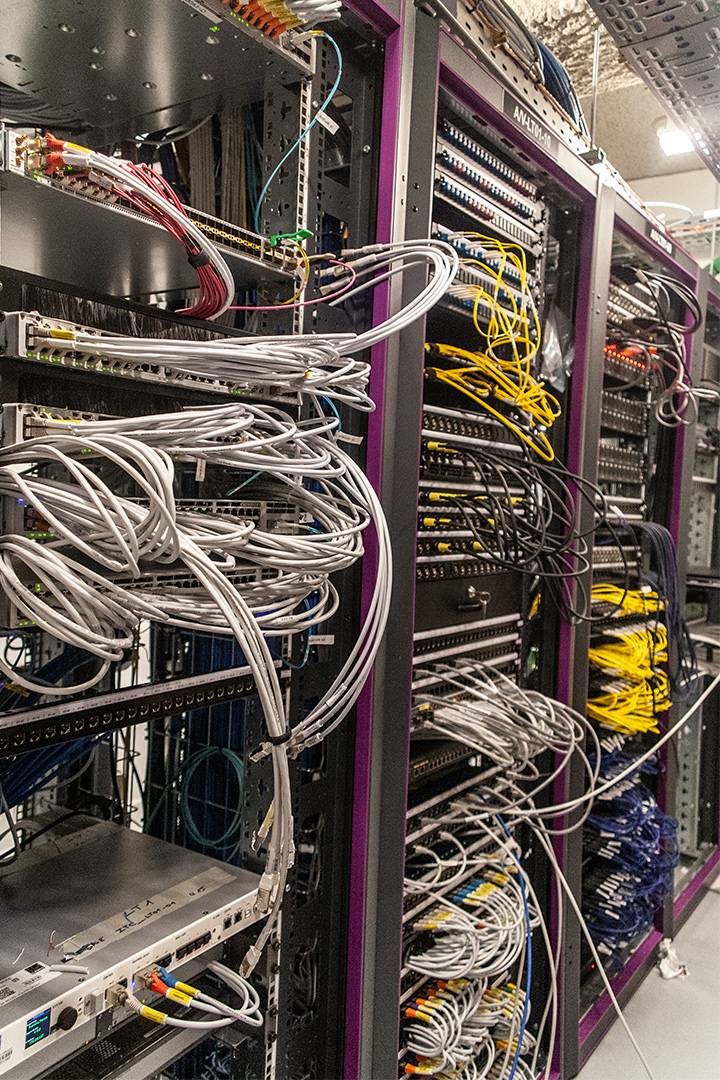
Philip Merscher : They have to. The main network infrastructure at the Maison de la Radio uses ST 2110 over a huge fiber-optic mesh because it allows audio, video and intercom to be distributed simultaneously. It also provides connectivity with France TV.
Following a tender for the mixing consoles, we selected the SSL System T S500, which operates natively in Dante. For that reason, all interconnections within and between the production studios use Dante. With Dante Domain Manager, we create protected bubbles around each studio that can be opened whenever several studios need to work together. Almost anything is possible… several studios can feed a single mixing point, or conversely, one studio floor can feed several control rooms.
Guillaume Le Dû : To bridge the Dante and ST 2110 network protocols, we use DirectOut Prodigy units. They convert the different formats to ST 2110 so the signals can be sent directly to the Centre Technique de Modulation, or CDM.
SLU : And what about the studio floor?
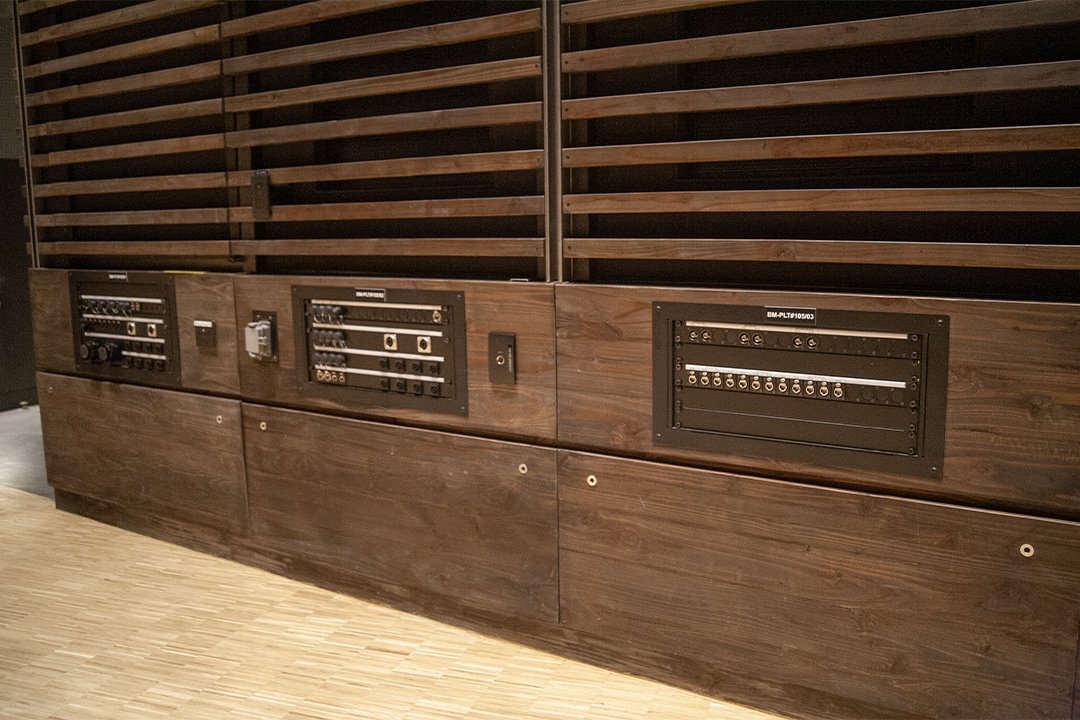
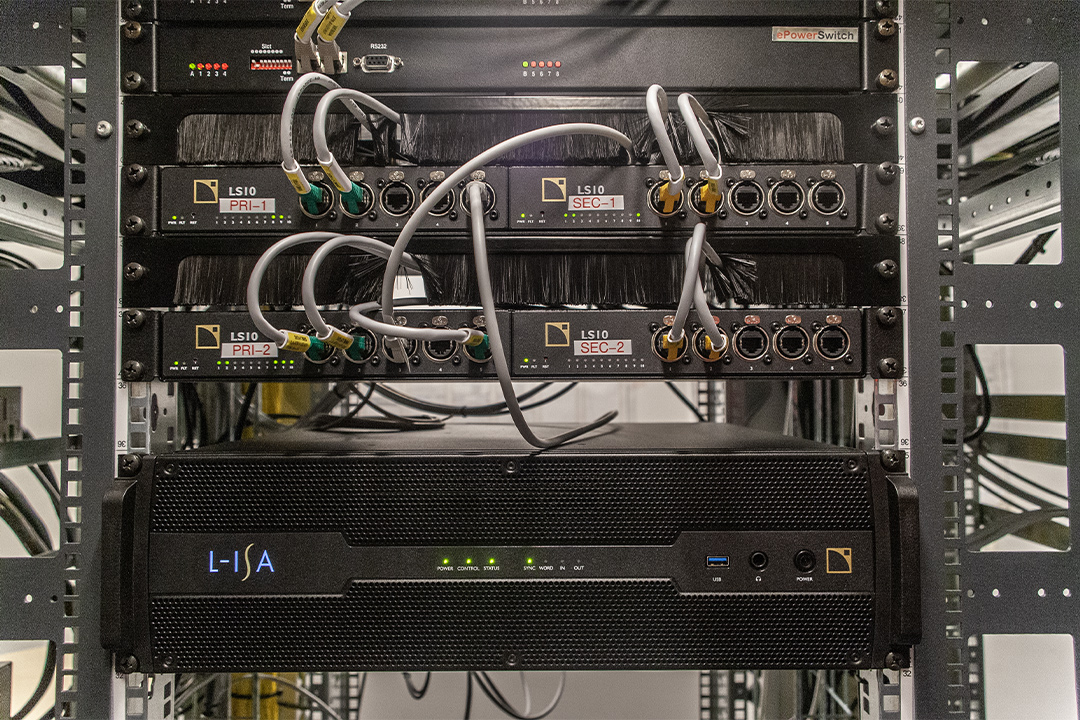
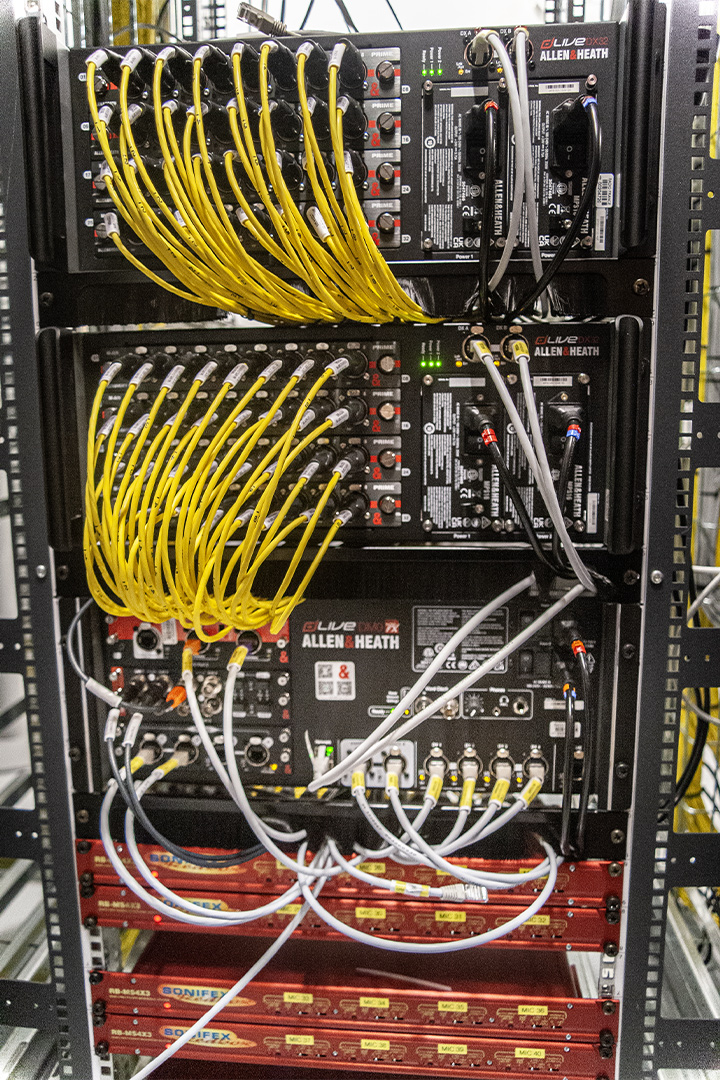
Jean-Benoît Têtu : The studio floor is equipped with numerous fiber and RJ45 connections that terminate in the technical room patchbay, allowing musicians to connect external equipment directly, as well as video equipment to our video control room. We have 64 channels of Sonifex analog splitters distributing the sources from the floor to the preamps of the three consoles: FOH, monitors and the control room. The FOH sound reinforcement console sends 96 MADI “object” channels to the L-ISA spatial audio processor. The same processor then feeds the FOH amplification, the LA7.16i, over an AVB Milan network.
SLU : How do you secure those networks?
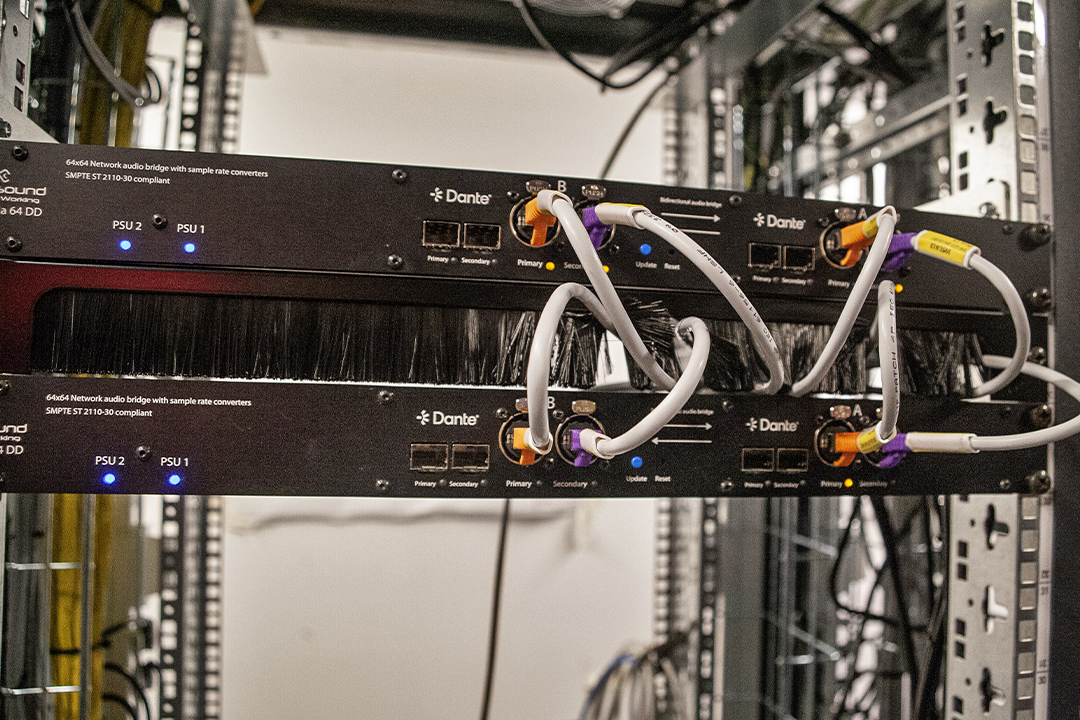
Guillaume Le Dû : All our working network segments are protected. This is where the Glensound Vittoria DD units come in, isolating the stage network from the production network, which has to remain secure. They are gateways that allow two Dante networks to communicate while remaining completely independent.
That is essential. If somebody connects a poorly configured device to the sound reinforcement network, it cannot jeopardize the production network used by the SSL console in the control room, which is shared across all the production studios.
SLU : Is Studio 105 really such a legendary studio?
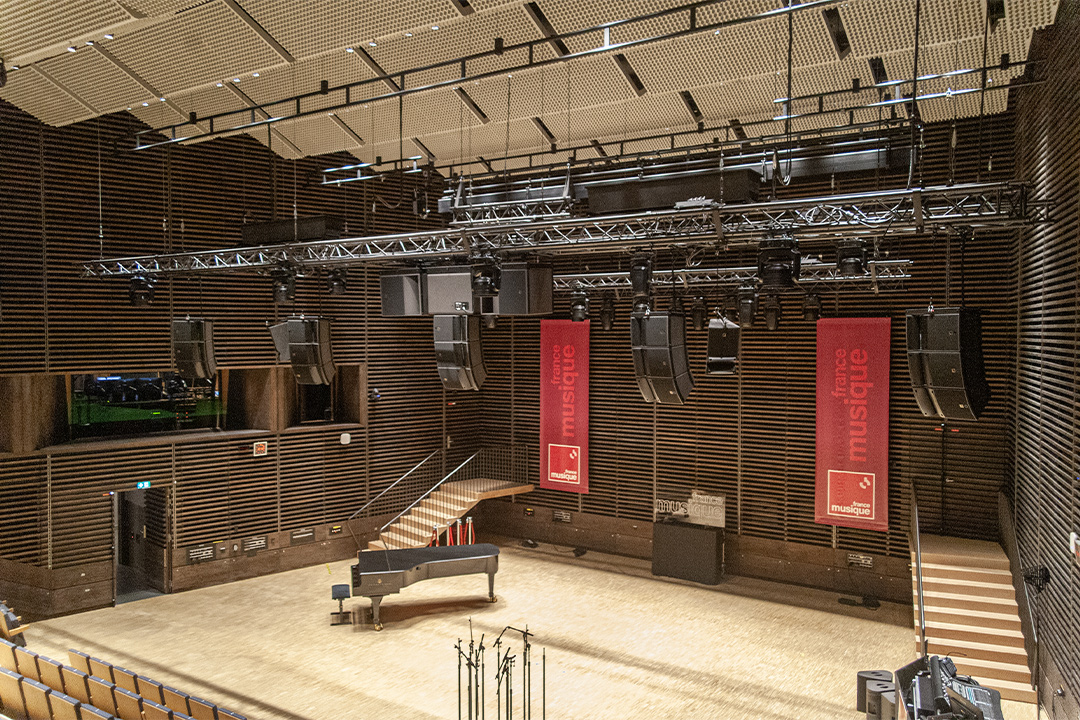
Philip Merscher : It may seem paradoxical because, with 250 seats, it isn’t the largest. The Auditorium seats 1,500 and Studio 104 seats 850. In its heyday, Studio 105 hosted around four concerts a week. And yes, seeing The Cure or any number of other legendary bands in such an intimate setting, just 2.5 meters from the singer, is pretty unforgettable. This studio has a soul. Its reopening will probably mark the return of public broadcasts for all our stations, which have a real appetite for using this studio.
SLU : The studio’s acoustic renovation will undoubtedly contribute to its success?
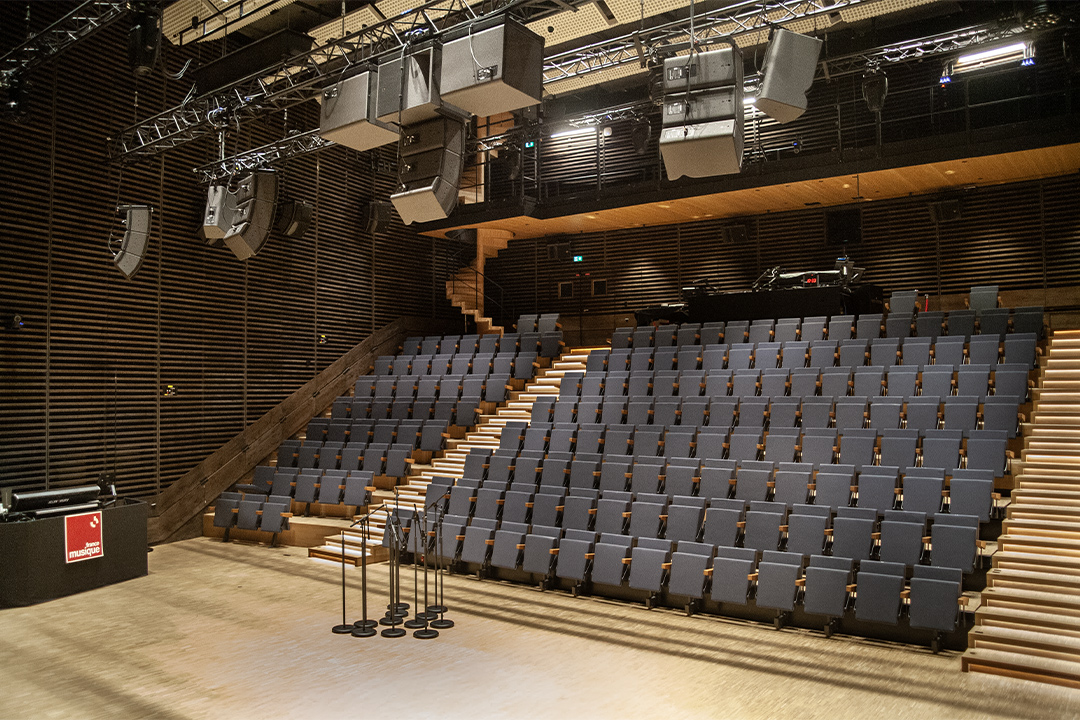
Philip Merscher : The studio has gone from light beige to a dark wood design, reinforcing its character as a performance venue. Large curtains can be used to reshape the space and create volumes suited to different programs. The seating has been optimized, and the first three rows are now retractable to accommodate camera positions or different stage configurations.
The acoustics were designed to overcome the acoustic constraints typically associated with a performance venue. The result is a very dry and precise sound, with an extremely low reverberation time of 0.6 second, controlled across the entire frequency spectrum. Combined with the relatively small room volume, that makes it ideal for high-level amplified music while retaining a sonic signature that remains very much that of radio.
SLU : In fact, acoustically, we are almost in a recording studio.
Philip Merscher : Like a recording studio, but with an audience and a radio sound. Here, the audience is attending a radio program. In addition to the visual experience, they get a bigger, more powerful live sound. It is a carefully balanced combination of studio, live performance and radio.
Guillaume Le Dû : Le Dû: Studio 105 can also be rented for various outside events such as conferences, presentations, live shows and record production. However, it is always operated by our own technical teams, who have a thorough knowledge of how the facility works and of the high audio standards required by Radio France.
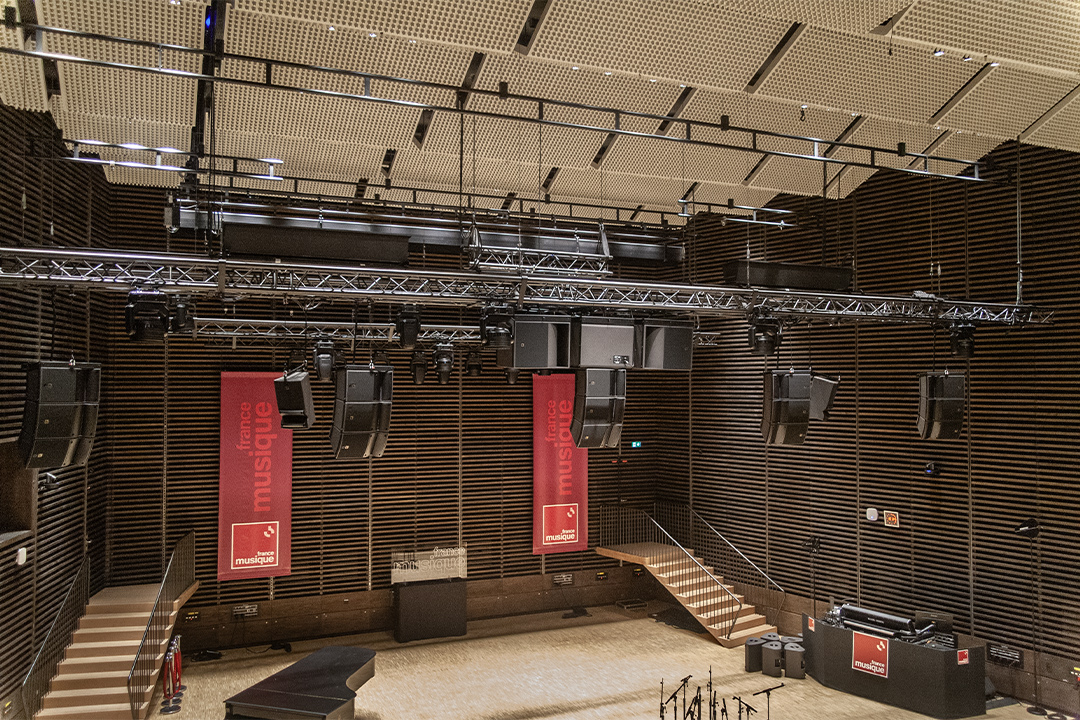
SLU : Is Studio 105’s sound reinforcement based on a spatial audio system?
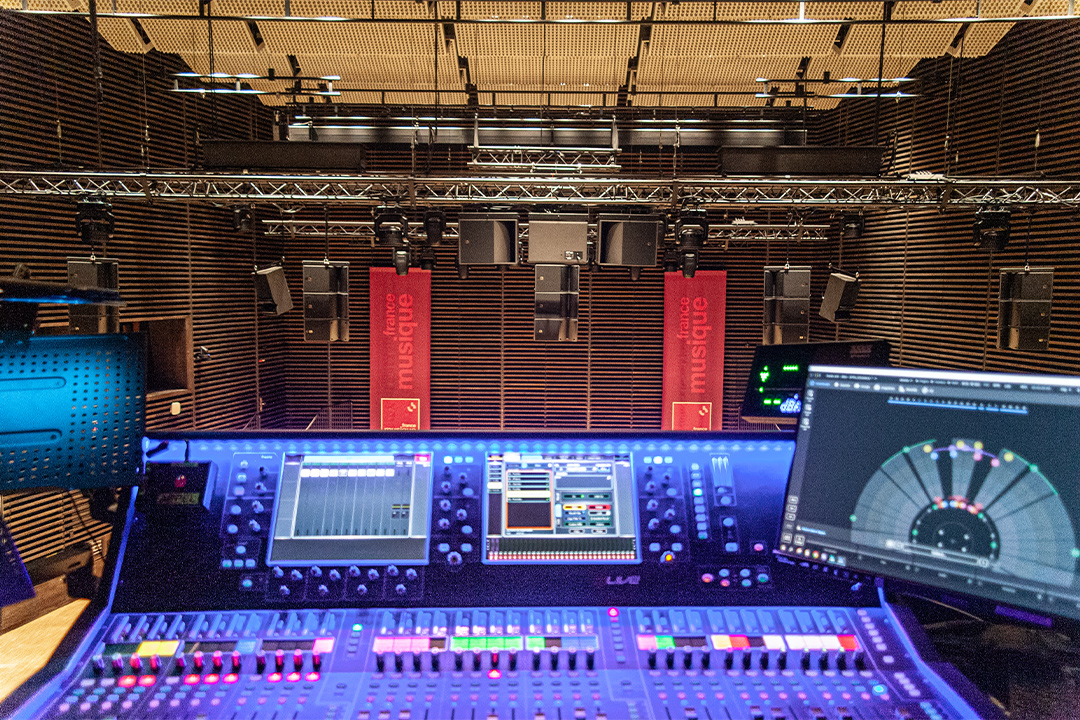
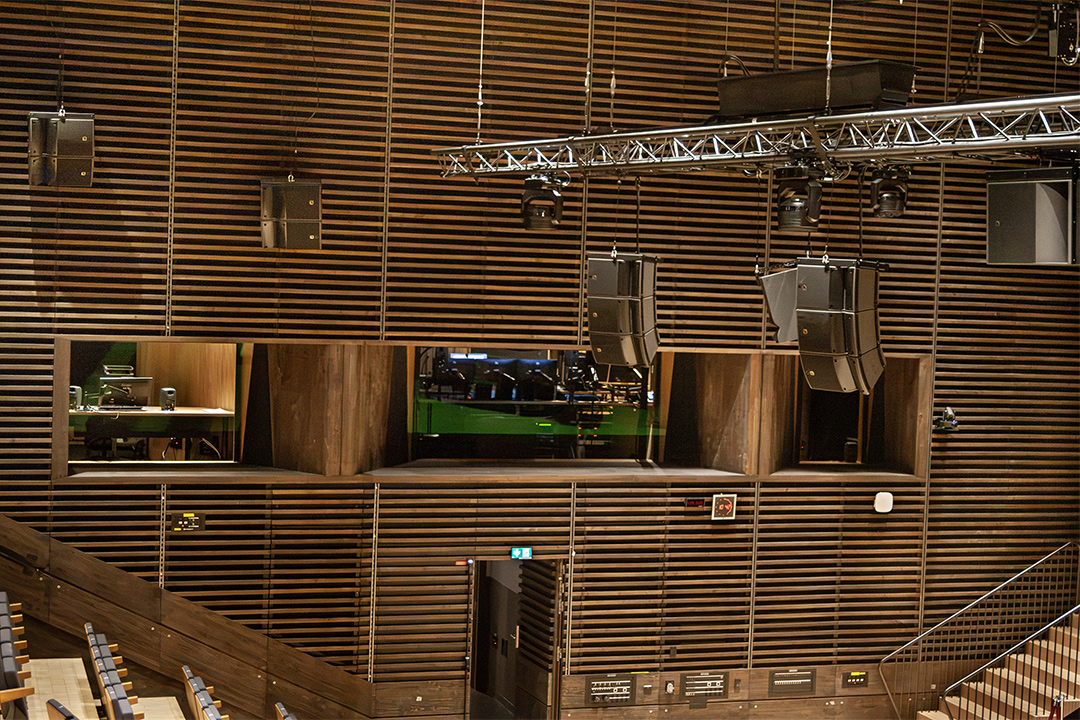
Jean-Benoît Têtu : Yes. Studio 105’s new sound reinforcement system is an L-ISA spatial audio system based on A10 constant-curvature line source loudspeakers. Each of the five frontal clusters consists of two A10 Focus cabinets with 10° vertical directivity above, and one A10 Wide with 30° below to cover the front rows. The 360° surround system also uses A10 Wide, while four coaxial X8 provide the overhead layer.
The main system has a low-frequency cutoff of 66 Hz and is complemented by three centrally flown KS21 subwoofers operating in cardioid mode, extending the response down to 31 Hz. The complete system is processed and amplified by three LA7.16i. For monitors, we have four L-Acoustics LA4X amplifiers, providing 16 amplification channels, together with X8, X12 and SB15 loudspeakers.
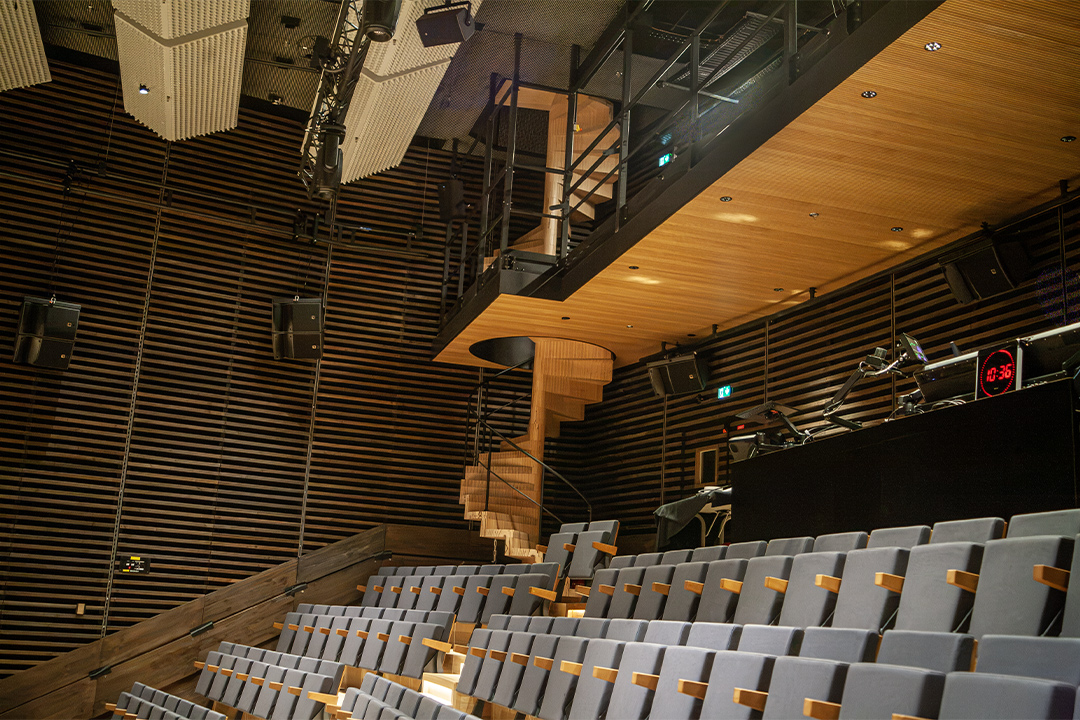
SLU : Combined with such tightly controlled acoustics, this L-ISA system produces a sound that is strikingly close to studio monitoring?
Jean-Benoît Têtu : The quality is definitely there. Although its latency could still be improved, L-ISA performs extremely well for most of our productions. Its object-based mixing approach allows every audience member, regardless of where they are seated, to hear and localize a source exactly where they see it.
That object-based approach, combined with excellent tonal fidelity and the immersive L-ISA Room Engine reverberation engine, gives the audience a very comfortable listening experience and an extremely realistic result. It is particularly well suited to jazz, classical or contemporary music concerts, acoustic reinforcement, electronic music and immersive program playback
That said, we are still looking at ways to optimize the system for productions requiring high levels of amplification, and particularly for musical genres whose traditional aesthetic, normally achieved through conventional stereo mixing, can be difficult to reproduce with this approach. If required, a stereo mix can still be handled through the L-ISA processor.
Philip Merscher : It is also important to point out that, like any properly equipped performance venue, the studio has an induction loop for hearing-impaired audience members.
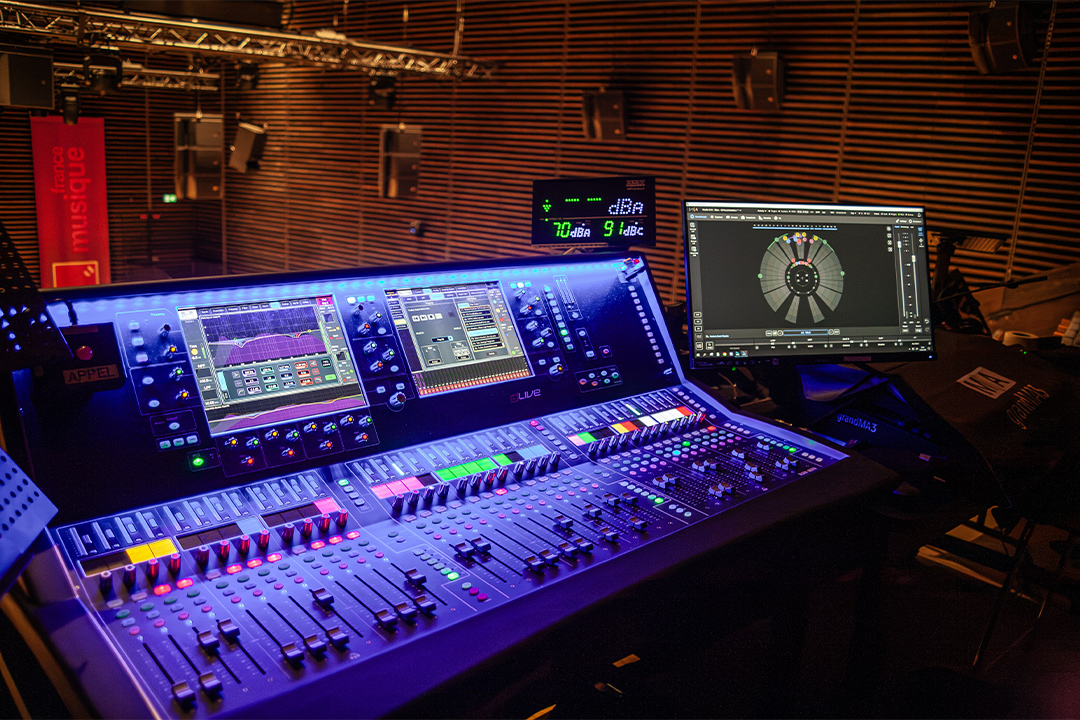
SLU : For the FOH and monitor consoles, you chose Allen & Heath?
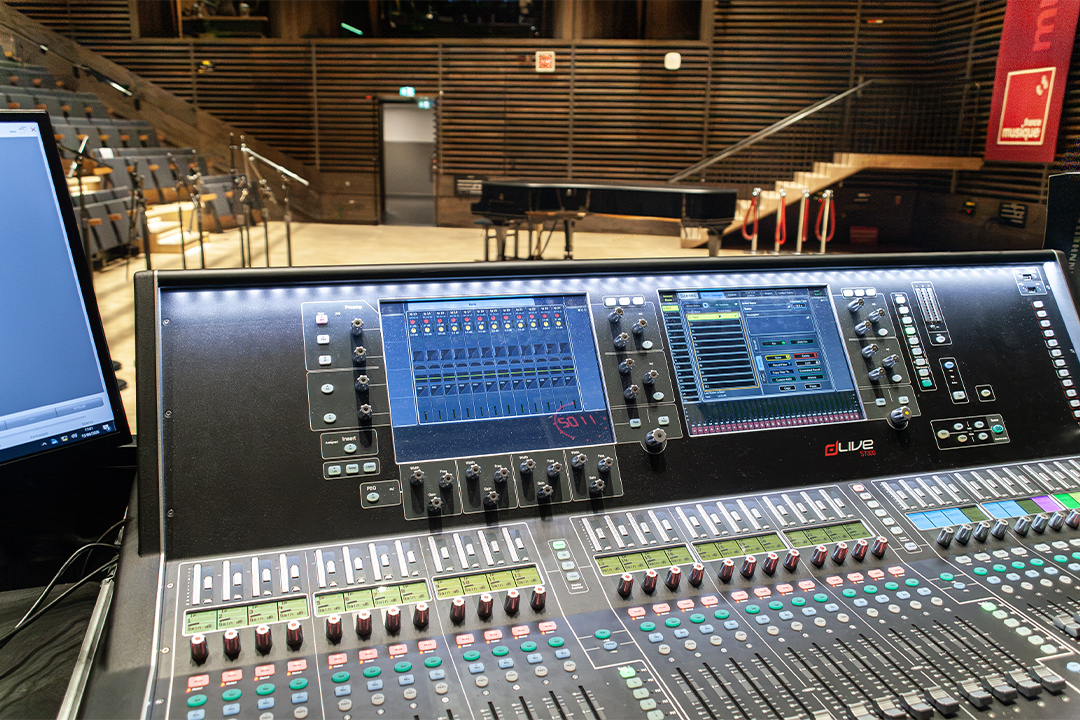
Jean-Benoît Têtu : Yes. We chose dLive for its low latency, ergonomics, modularity and reasonable cost. Both the FOH and MON positions use S7000 surfaces with DM0 audio engines. Modular DX32 racks equipped with M-AIN PRIME cards provide 64 channels of preamplification to each of the two sound reinforcement consoles.
SLU : What about microphones?
Guillaume Le Dû : We have 64 microphones for music and up to 16 microphones for room ambience and applause. Half are mounted in the ceiling above the audience and half are positioned at floor level on stands, including shotgun microphones, for example. For radio, applause is extremely important because it helps the listener feel immersed in the event. The exact microphone models used for any production are always left to the discretion of the sound engineer operating the studio.
SLU : And what about wireless?
Philip Merscher : It will be a Sennheiser Spectera system. We chose it because, quite frankly, it offers nothing but advantages.
Having a bodypack that can handle both microphone and monitor functions, and potentially push-to-talk for communications, makes inventory management much easier when we need to distribute packs throughout the studios. It is Dante-native, so it integrates perfectly with our facilities. We also extend it to MADI so FOH, monitors and the control room can manage it independently.
Snapshot management, control options such as headphone connection and listening levels, and permanent bodypack labeling provide truly exceptional ergonomics. We are equipping Studio 105 with 16 links, 16 in-ear monitor packs, 12 main microphones, four antennas and one Base Station. The links can be configured in linear 48 kHz/24-bit mode to provide wired-quality audio. And all of that fits into 1U. It’s incredible!
SLU : Spectera also provides a major advantage in terms of antenna distribution?
Philip Merscher : We have to cover not only the studio itself, but also the dressing rooms and access areas so the host and artists can move around freely. This new way of handling the antennas as data over fiber-fed RJ45 connections is extremely convenient for us and means we can respond very quickly to any production requirement.
SLU : Do you have a tracking solution?
Guillaume Le Dû : Not yet, but we are thinking about it. In larger studios such as 104, with a much wider stage, we produce concert-fiction shows with actors, musicians and Foley artists performing on stage. Equipping them with trackers would be a real advantage.
SLU : Was the studio control room completely redesigned?
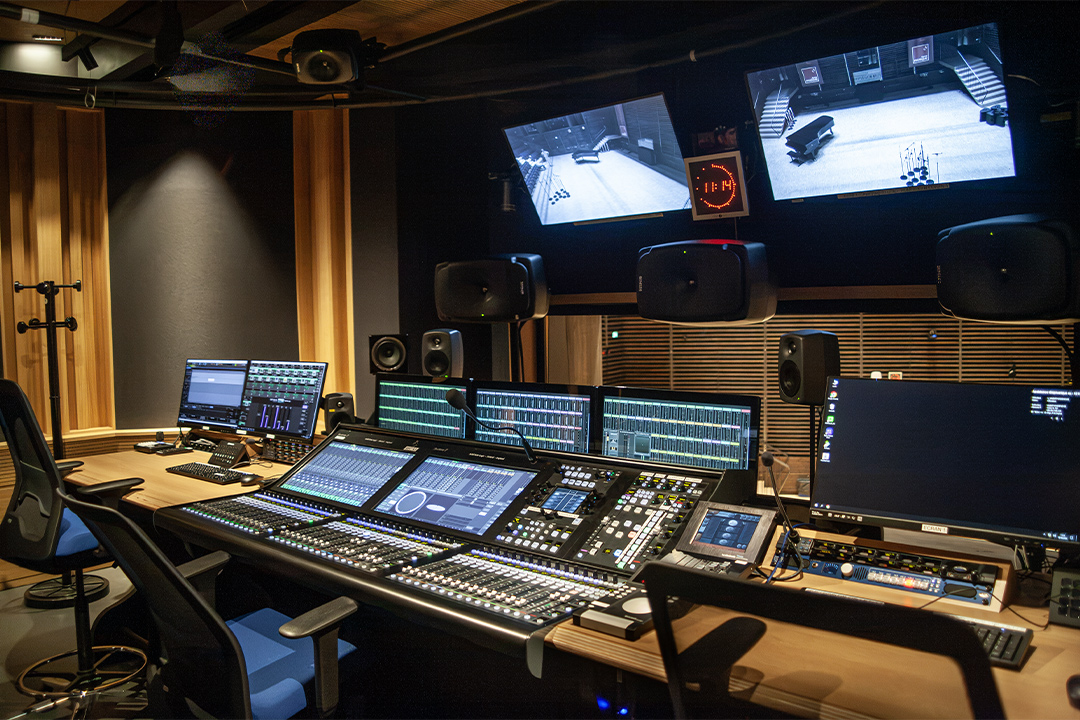
Philip Merscher : Previously, the console was positioned perpendicular to the window. That was the design approach at the time. The intention this time was to make the room symmetrical by moving the console so that it faces the window. It creates a connection with the stage: while mixing, you can feel the warmth and enthusiasm of the room. On the other hand, reorganizing the acoustic space in this way meant losing some room volume.
SLU : You installed an immersive monitoring system?
Philip Merscher : We generally work in 7.1.4. We are not specifically seeking Atmos certification, but we can monitor Atmos without any problem. The important thing is for the system to be completely operational for our requirement to produce stereo, 5.1 and binaural versions simultaneously.
Guillaume Le Dû : Our regular programs are broadcast in stereo, while the players in Radio France’s applications provide 3D audio options in binaural and 5.1.
Philip Merscher : For classical music, we have clearly defined methods and workflows. There is something almost self-evident about reproducing a realistic acoustic space inside a room. The chosen listening perspective can vary: some sound engineers prefer to place the listener in the conductor’s position, while others prefer a perspective from within the audience. For other genres — jazz, rock, chanson, electronic music and so on — the mixing strategy obviously depends heavily on the project. When artists come here, we have to remain faithful to their original intentions. But if they want it, we can offer a more creative alternative based on spatial mixing that can add tremendous value.
SLU : Studio 105 is nevertheless designed around object-based mixing?
Philip Merscher : Absolutely, and our innovation department encourages us to work that way. The audio object is the most appropriate format for generating all the different delivery formats we use. We are developing the idea of eventually providing ADM — Audio Definition Model — masters that can be rendered into different formats and could ultimately become our archival format.
SLU : Is stereo gradually becoming a thing of the past?
Philip Merscher : Slowly. It is a complex transition because stereo is still deeply established, with very well-defined mixing methods — mix “glue,” bus compression and so on.
Guillaume Le Dû : Spatialization gives you a much larger playground, with the additional advantage of creating separation and reducing masking.
SLU : For the control-room console, you chose SSL?
Guillaume Le Dû : All our production-studio control rooms are equipped with SSL System T S500 consoles. Here, we selected the M version, which has a smaller chassis and meter displays that can be relocated so they do not obstruct the view into the studio. It is a broadcast console that gives us everything we need in terms of routing and processing for both stereo and multichannel production. It includes a number of very good internal effects that could allow us to mix everything entirely in the box. All sources from the studio floor feed the SSL preamps directly, and we operate at either 48 or 96 kHz. Our current configuration provides 420 processing paths and can be expanded to as many as 800.
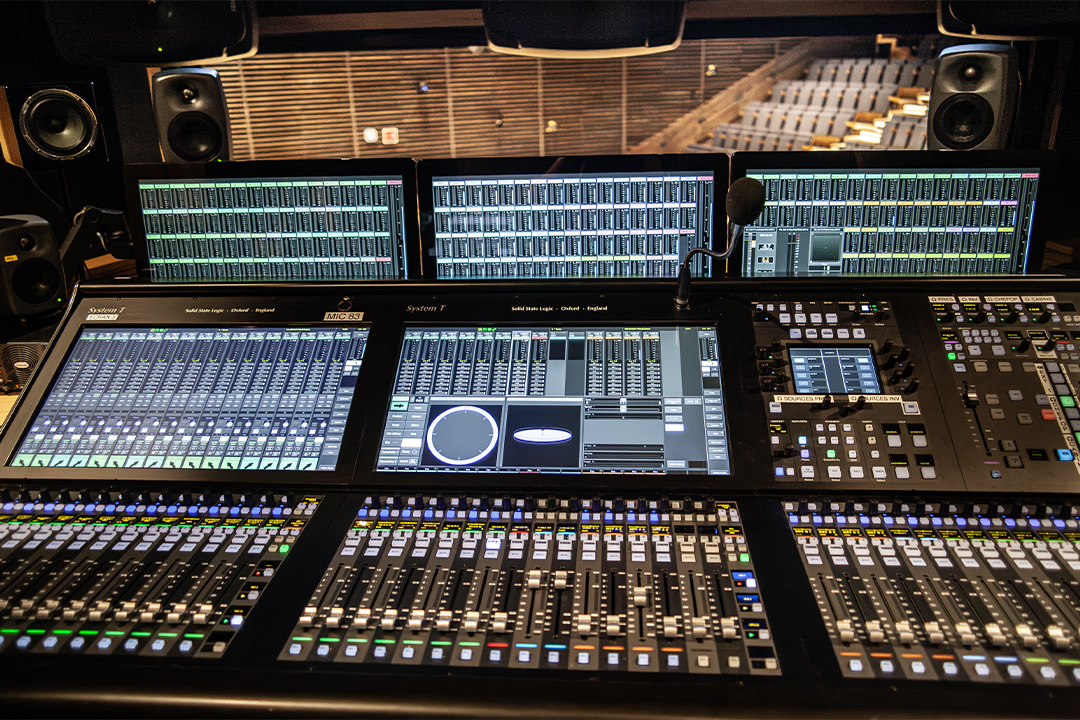
SLU : The SSL S500 has an open architecture that has to be configured?
Guillaume Le Dû : Exactly, and that is part of my role within the production studios. The console has to be configured to ensure consistent interoperability between the studios and to interface with the outside world.
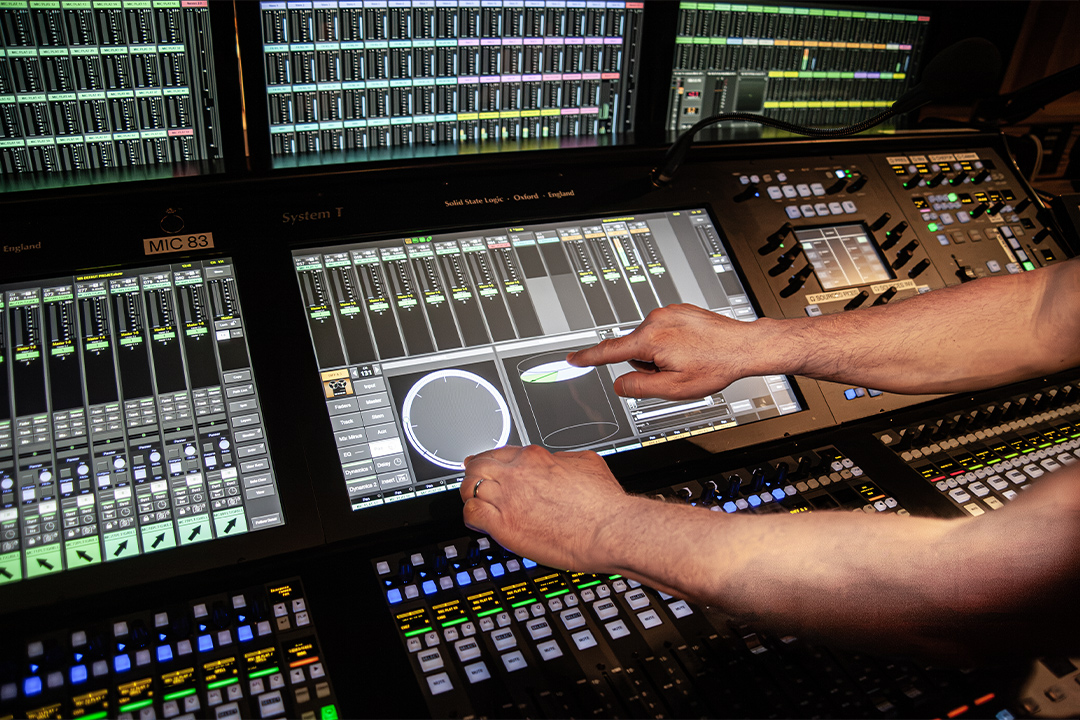
SLU : Is it a good choice for managing spatialization?
Guillaume Le Dû : The SSL provides a human-machine interface that can control spatialization systems over OSC. We can even link it to the FOH sound reinforcement system in the studio and directly control the L-ISA objects.
Philip Merscher : In the future, it would be interesting to develop a workflow that encourages collaboration between creators and Studio 105’s technical teams. With the assistance of a technician, creators could control sound spatialization from a tablet, with complete consistency between the L-ISA system used for monitoring in the room and the object-based mix handled by the SSL console for the final production.That approach would ensure that the artistic intent is preserved throughout the entire production chain.
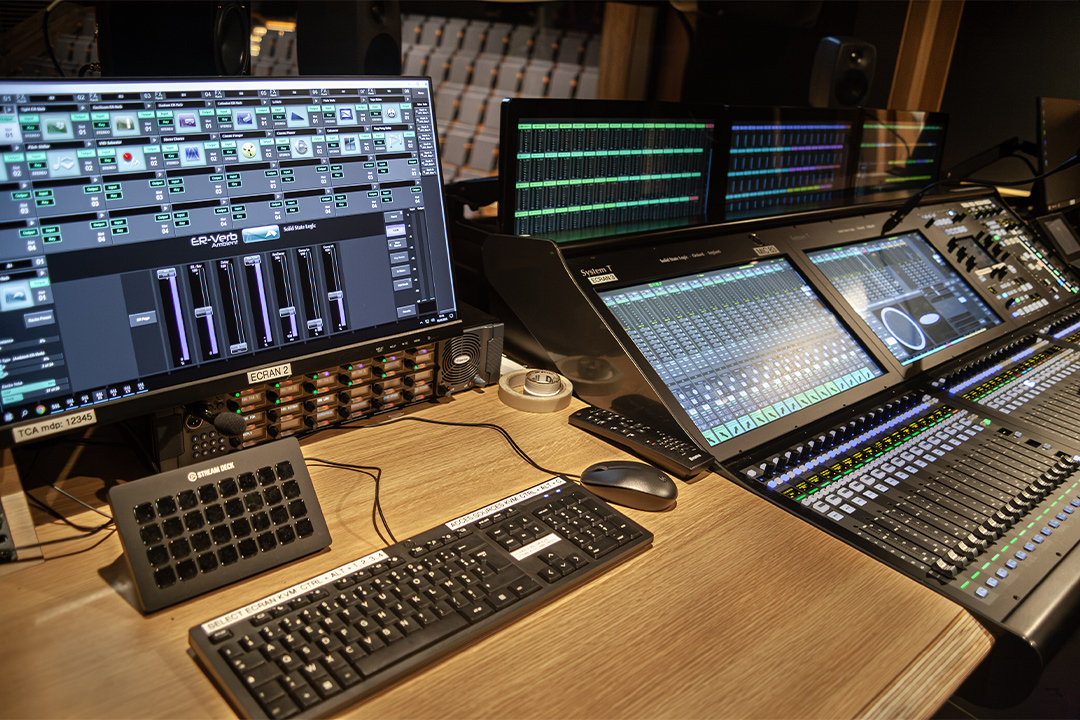
SLU : And Genelec monitoring that is remarkably accurate and consistent in its reproduction of the soundstage?
Philip Merscher : Radio France has a large inventory of Genelec loudspeakers, which we continue to use here in the Studio 105 control room. We use 8361s for left, center and right, 8351s for surround and 8331s for the height channels, together with two 7380A subwoofers.We particularly appreciate these loudspeakers because they provide very consistent monitoring across a relatively wide listening area. That is essential in this studio, where the sound engineer sits at the console, with a producer/director position to the right and an assistant position to the left. A mix may also need to be approved by several people listening at the same time.
We have added two 8020s, which we have known well for years, as a small-format nearfield stereo reference, as well as the indispensable Avantone to simulate a mono radio receiver. The monitoring system is calibrated using Genelec SAM, which provides a solid working reference that we may fine-tune very slightly by adjusting a few parameters.
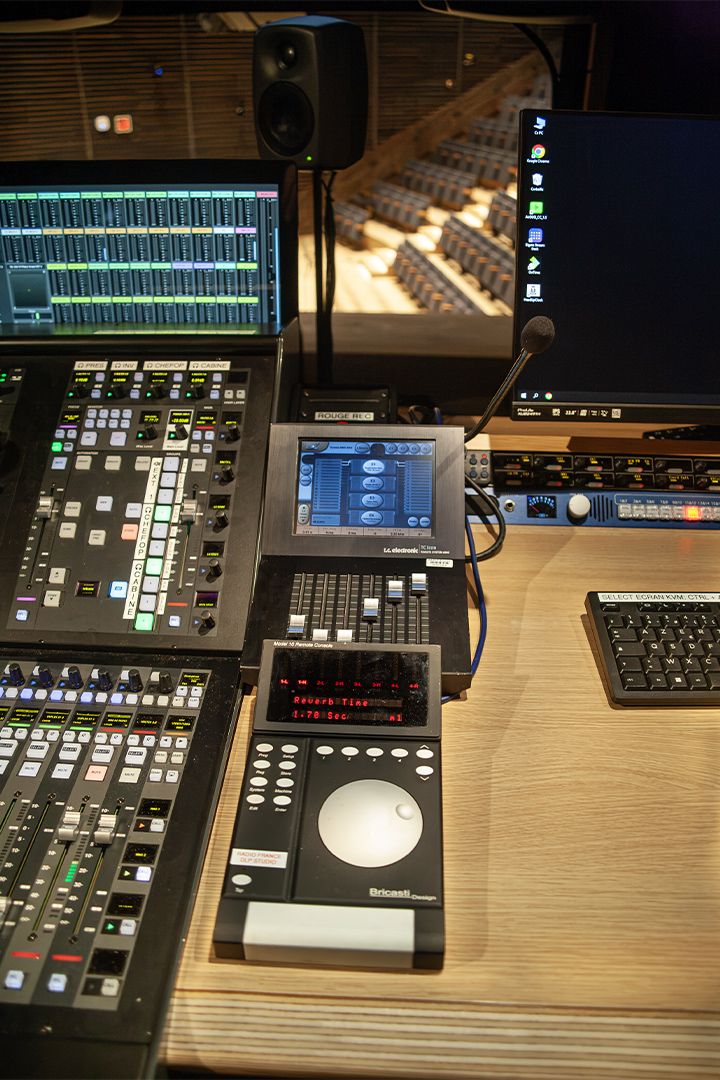
SLU : And what about processing — inside the SSL or externally?
Philip Merscher : The SSL console provides an extensive range of internal processing, with the advantage of supporting multichannel operation all the way up to 9.1.6. For us, it is very valuable to have a complete and versatile mixing tool with everything integrated. That said, our mixing setup also includes external hardware inherited from the past, including Bricasti reverbs, a TC M6000, a Lexicon 960 and even PCM70s. That allows us to make the transition between older working methods and this new mixing environment.
SLU : Are plug-ins an option?
Philip Merscher : For the moment, there is still a lot of attachment to these hardware processors, and we continue to use them very regularly. However, our high-volume production environment requires a fast pace, and maintaining this equipment in good working condition can become difficult. For that reason, we are considering solutions such as Waves SuperRack LiveBox or the Fourier Audio Transform.engine, which would give us access to the full power of VST3 plug-ins and allow us to share them across the studios.
SLU : And what about recording and playout?
Philip Merscher : We use Nuendo, Sequoia and Pro Tools digital audio workstations. Pyramix is also available, although it is more commonly used for classical music productions carried out in other studios. Although most of the work here involves producing recorded programs, in some cases we also need to be able to broadcast live. That means having access to all the station branding and all the tools found in a conventional on-air studio. For that purpose, we use Netia playout systems with the rundowns and cartwalls corresponding to whichever station is on air, giving us access to all the broadcast elements exactly as we would have in an on-air studio. That system will soon be replaced by Zenon.
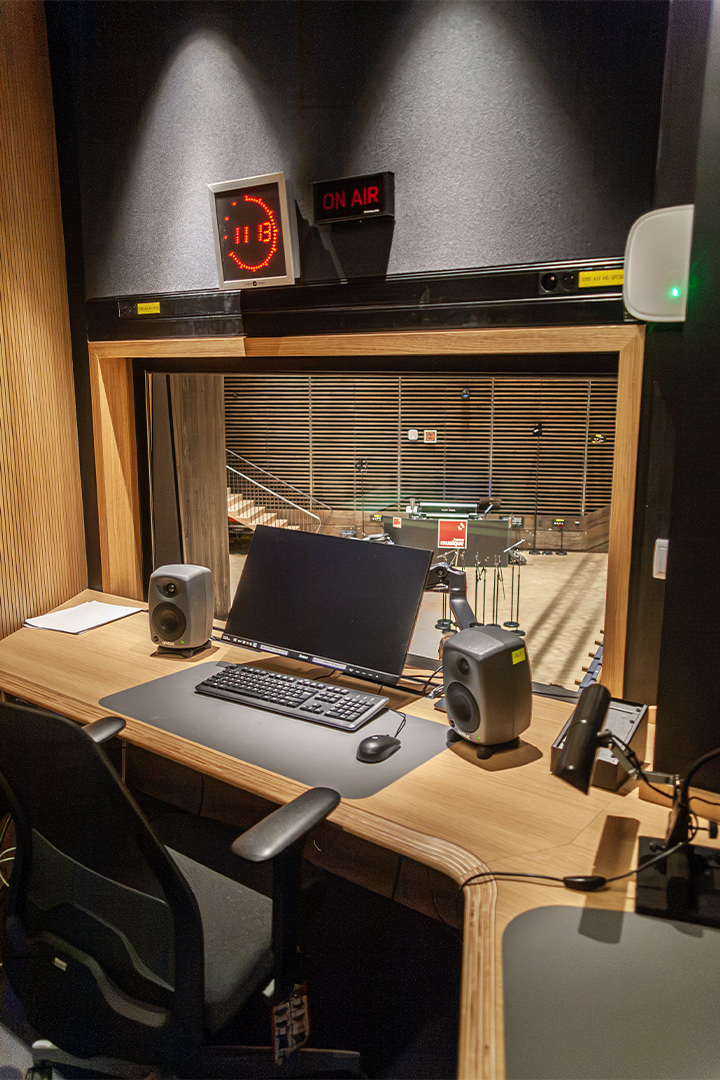
SLU : This really is a rather magical studio, bringing together live performance, recording and broadcasting…
Guillaume Le Dû : In our hearts, at least, it is the most beautiful. We worked here before the renovation and experienced some intense moments on legendary productions. Despite all the changes the studio has undergone, it has retained its soul. Since it reopened, many of Radio France’s engineers and producers have wanted to use it. There is something special about this studio, an aura created by its history and probably also by its intimate scale. Its technical equipment is superb, and the reactions from audience members and professionals attending the first programs have been unanimously enthusiastic.
Philip Merscher : What I find special about this studio is the connection with the stage. You are very close to the artists and genuinely part of the performance. That direct view of the stage completely changes your ability to interpret what you are mixing. In a conventional studio, you often feel removed from what you are recording. You are shut behind a wall, and the only impression you have left is what you hear at the end of your faders. Here, you feel as though you are in the room. You experience its warmth and its enthusiasm. And that is what makes this studio unique.
Studio 105 is a place where tomorrow’s audio heritage is being created. It is a unique production facility where Radio France’s engineers have succeeded in combining the best technologies of a live performance venue, recording studio and on-air broadcast studio into a single concept of impressive technical rigor and creative power. It is a sonic treat for the audience, the listeners, engineers and producers — not to mention the hosts and artists.
I can confirm that it had been a long time since I last experienced that very particular and deeply satisfying feeling you get inside a truly professional studio worthy of the name. At a time when facilities of this caliber are becoming increasingly rare, Radio France deserves credit for preserving this level of excellence and continuing to build control rooms according to the highest professional standards. And don’t forget: concerts in Studio 105 are generally free. So don’t hesitate — go and get yourself a large dose of sonic pleasure… and if you can’t make it there, listen on the radio.
And more informations on Maison de la Radio et de la Musique