
At the crossroads of industrial metal, dark synth, and a radical cyberpunk aesthetic, Perturbator has always been an exceptional electronic project. His music is massive, cinematic, both raw and controlled.

For his European autumn-winter 2025 tour, recently concluded at the iconic Bataclan in Paris, the challenge was not simply to light a concert, but to visually translate this intensity. French lighting designer Nico Riot, accompanied by Camille (Clair Obscur), found the creative axis of the project during a photo shoot conducted by the artist at the Rudolph Tegner Museum and Statue Park in Denmark.
Discovering the images captured in this brutalist and monumental location, the designers immediately perceived a resonance between Tegner’s massive sculptures, which exude power that is both structured and refined, and Perturbator’s sonic universe. “Perturbator did a shoot with photographer Andy Julia at the Rudolph Tegner Museum. When I saw the photos, the design direction was obvious,” explains Nico Riot, who used between 20 and 28 Chauvet Professional COLORado PXL Bar 16 moving lights provided by Pan Tilt to transpose this monumentality onto the stage.
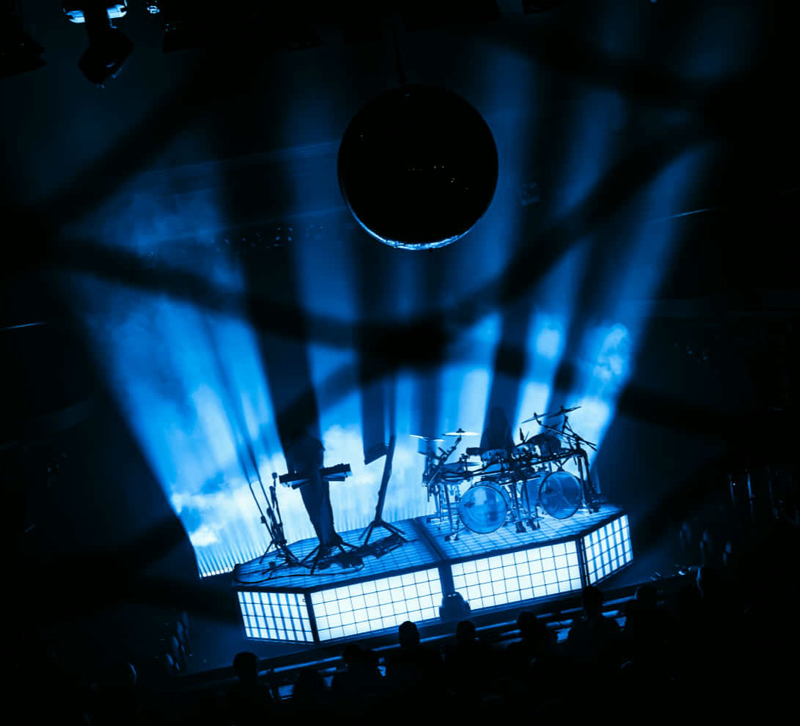
“The gigantism and details of the sculptures called for the creation of a video monolith capable of recreating this atmosphere on tour,” he continues. “There are only two musicians on stage, Perturbator and his drummer, and I wanted them close to each other, centered around a strong piece.”
One of the key elements of the museum, its octagonal glass ceiling, became a major visual anchor. On stage, this geometry was transformed into an octagonal riser structuring the entire setup around a monolith that acts as a dramaturgical entity, gradually revealing itself throughout the show. Sometimes incandescent, other times almost absorbed by darkness and fog, it modifies the dynamics between the two artists, bringing them closer or separating them physically when the risers open.
“The show is divided into acts, so we initially only used part of the monolith,” says Nico Riot. “Then the risers open and reveal the structure in its full dimension. It also unveils new beam lines, creating another perspective and multiplying sources and possibilities.”
This first opening movement, in the middle of the concert, acts as a true visual shift. “It’s striking for the audience to see the two musicians separated on either side of the stage. The riser allows me to refocus attention on a precise point when needed. The monolith is always present but never fully revealed at first.”
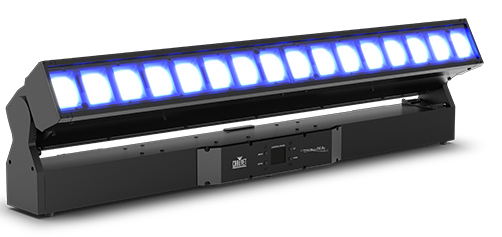
To emphasize the octagonal structure, Nico Riot surrounded the central element with 20 PXL Bar 16 (28 in festival configuration, with added laterals).
“They provided us with superb depth effects, creating a kind of luminous veil between the band and the audience,” he explains. Mostly positioned along the X-axis while the beam projectors work on the Y-axis, the bars structure the space. They densify the stage and enhance this tense and immersive atmosphere.
Seeking to create “the opposite of a classic metal or EDM show,” Nico Riot deliberately avoided the hyper-kinetic visual language often associated with these aesthetics. “There are very few movements, very few effects, or rapid position changes,” he clarifies. “Perturbator’s music is already extremely intense. I was looking for a way to maintain this intensity without constantly projecting light toward the audience.”
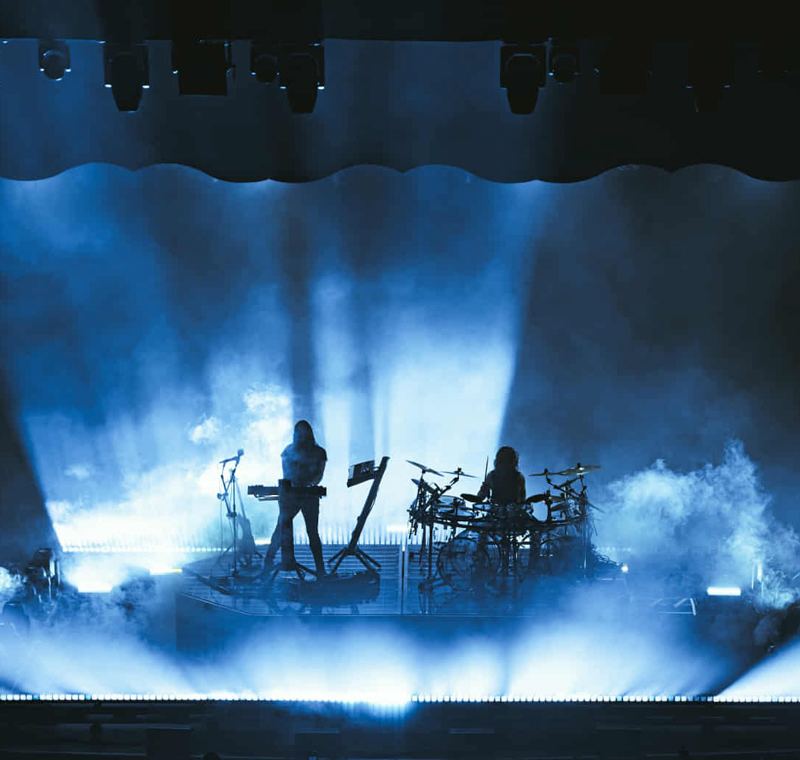
Rather than multiplying frontal effects and direct strobes, he built tension through atmospheric density and micro-intensity variations. The strobes are mostly directed toward the back of the stage or held in a neutral position, helping to shape the light matter rather than solicit the gaze frontally.
“I used an impressive amount of haze and smoke,” he adds. “The opacity of the air softens the perception of the strobe, and the colors help smooth the rendering. By carefully adjusting frequencies and dimmer effects simultaneously, you can generate real visual intensity without it becoming overwhelming.”
Alongside his lighting team leader Léna Marinot, Nico Riot directed this 10-universe show in MIDI. Subtlety thus becomes a central tool. “An element can operate at 1% for several minutes, waiting for the right musical moment to explode.” This work on very low intensities allows creating strong moments without constant saturation.
“I had never programmed an electronic project this way. I asked my friend Pierre-Claude for advice, and he guided me toward MIDI. This approach facilitates reorganizing sequences when the artist makes changes during the tour.” A method particularly suited to a show whose energy constantly evolves.
“I can’t wait to work with Perturbator again to push this design even further,” concludes Nico Riot.
For more product and general information: www.chauvetprofessional.com