
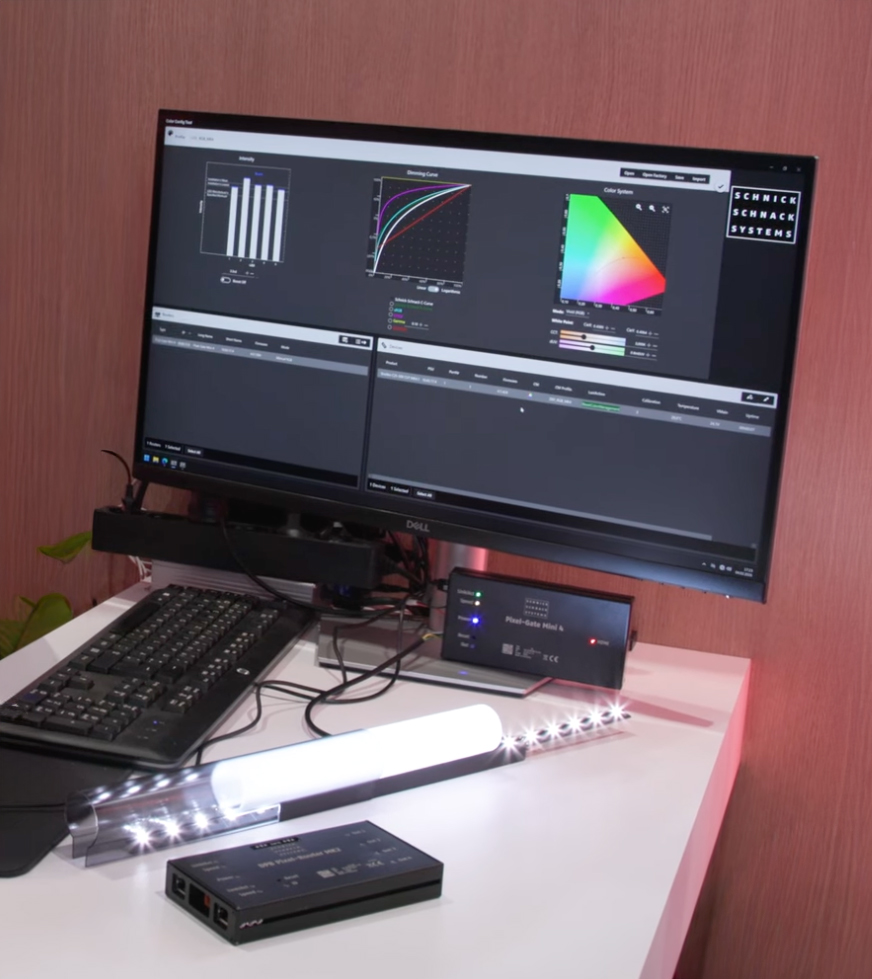
The 4th generation LED Strips of the C series present numerous advantages for integration: Nichia RGB LEDs individually calibrated at the factory for reproducible whites and colors, and a driver associated with configuration software. It is presented to us in this video by Erhard Lehmann, CEO of Schnick Schnack Systems.
Schnick Schnack Systems, the German manufacturer, is well known for the quality of its LED Strips integrated into large projects worldwide, on TV sets, in luxury hospitality, museums, stadiums, and two years ago in the first-class passenger lounge at Charles de Gaulle Airport, as specified by Yvan Guyot, head of the architectural lighting department at ESL France.
The C range arrives in its 4th generation with new Nichia RGB LEDs that make it possible to produce true whites, which is quite exceptional in the LED world. The LEDs are individually calibrated at the factory by spectrometry, which guarantees perfect homogeneity of a line LED Strips. They are controlled by a driver/power supply with feedback. A dedicated software allows, with one click, to calibrate the initial color temperature of the bar between 3,000 and 6,500 K, for example at 4,500 kelvins, while respecting the RGB balance in the color spectrum.
This new Nichia RGB LED has an emission surface twice as small as that used in the previous generation and a higher luminous efficiency. It is 25% more powerful in terms of light output and consumes less energy. It therefore makes it possible to reduce the number of power supplies required in an installation.
Because the LEDs are soldered onto a rigid PCB that integrates the control electronics, the driver receives feedback that allows it to recognize the type of bars to which it is connected and their number of LEDs; it therefore knows how to manage their flux and limit the current of the entire installation.
It also knows whether the bar is still within factory calibration standards, in other words if an LED is defective. In this case, it will emit an alert because a single defective LED will cause a drift of the assigned white and a break in the homogeneity of the installation.
Another advantage of the feedback between LED Strip and driver concerns the longevity of an installation in which it will be easy, in the event of any problem – failure or breakage – to replace it with a new one, possibly brighter, and adjust it to the same level as its neighbors integrated several years earlier. Even if the animation signal is in 8 bits, the electronics will emulate 16-bit control for very fine and smooth management of color variations and dimming.
As an option, Schnick Schnack provides white diffusers and black diffusers ensuring better contrast and greater discretion in a dark environment when the LEDs are off. They have been specially designed to respect colors and optimize flux.
This new generation of LED bars in the C range is already available with a 12 mm pitch and 25 cm length, and with a 50 mm pitch and 25 cm or 50 cm length.
More information on the Schnick Schnack Systems website