
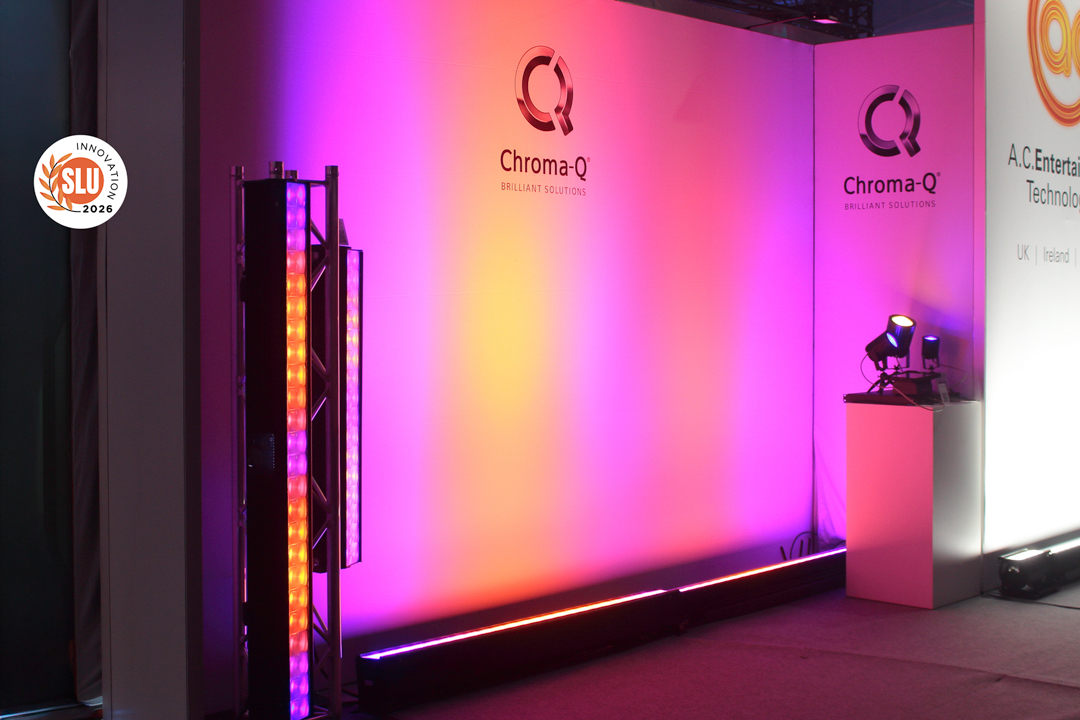

Chroma-Q’s R&D engineers are making a big statement. The Color Force 3 is a high-performance fixture intended for cyclorama, theatre, architectural uses, and live applications with effects.
Thanks to its high optical and colorimetric performance, its advanced user interface design, and its innovative technical solutions, Chroma-Q has wins an SLU Innovation Award for the Color Force 3.
Ten years after the release of the Color Force II, the North American brand presents its successor which, as we will see, brings real added value. Of course, it retains the DNA of the previous products: a linear format and LED sources, but now with competition-level performance. Here, the focus is color. And although the newly designed fixture does not neglect white light and achieves a CRI above 90, its colors are truly exceptional.
Paul Pelletier, the R&D engineer presenting the product, puts it very clearly: “We see fixtures everywhere adding white, lime, mint… None of that helps color; on the contrary, it only improves white rendering.”
To achieve the level and visual quality they demanded for such an update, the Color Force 3 adopts new 120 W RGB+Amber cells. These LEDs are driven at an effective 40 W to ensure a high level of stability, exceptional lifespan, and to maintain the calibration developed by Chroma-Q, which uses a unique process to achieve pure color saturation.
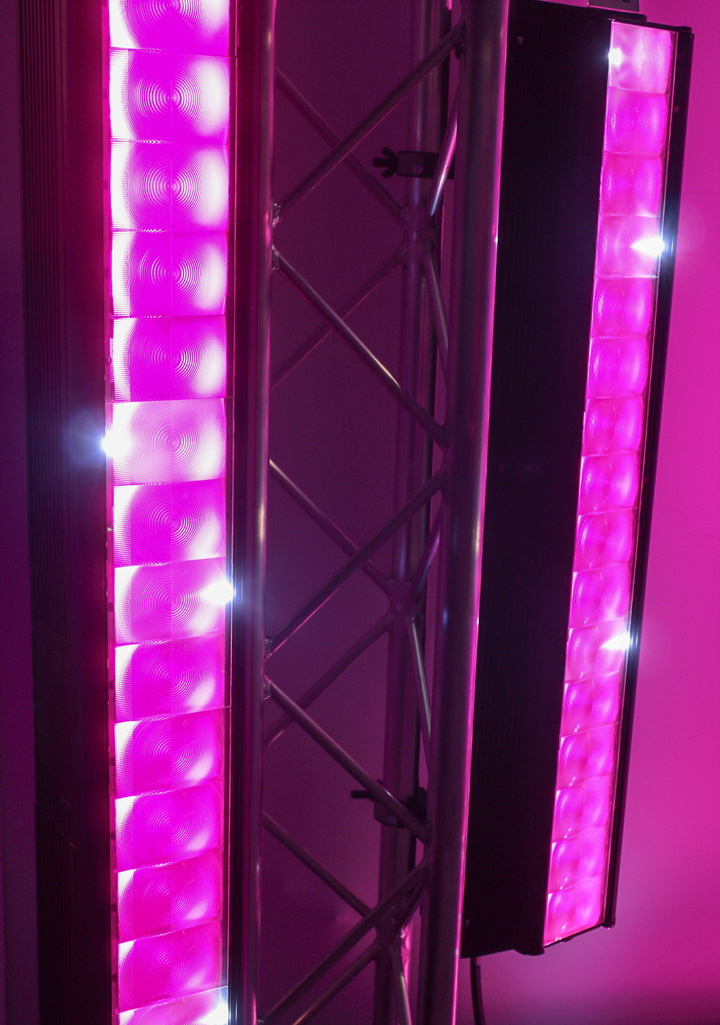
The hues are visually convincing, pastels are clean, and primary colors are highly saturated. For example, the blue wavelength goes down to 450 nanometers, allowing the production of beautiful violets, magentas, and deep greens. “Lowering the wavelength further would disrupt the colors, with a pure blue shifting too much toward violet,” explains Paul.
A major redesign effort has also focused on the lens, whose shape satisfies both cyclorama users, thanks to extremely even light distribution and those who want to see the source directly.
The light focusing is achieved through a redesigned Fresnel lens that keeps the concentric look while softening the focusing properties compared to traditional optics.
Since the fixture is IP65, the manufacturer decided to place the lens outside the sealed enclosure, making it removable. This innovative system is called FlexOptics. Looking for even more versatility? No problem. Along the body of the fixture, engineers integrated independently controlled white LEDs, called SparQle, collimated into a 15° beam at 7000 K. This adds a good dose of effects to an already powerful fixture.
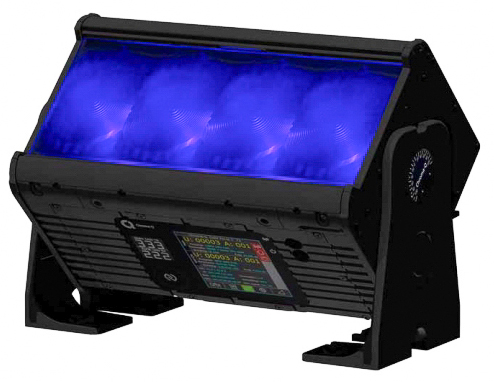
The Color Force 3 is available in three versions: 30 cm model with 4 main sources RGBA and 8 white SparQle LEDS, 1.2 m model with 16 main sources and 32 white LEDs, 1.8 m model with 24 main souces and 48 white LEDs
As we continue exploring the fixture, we take a look at the control interface—and what a pleasant surprise! The screen and software are presented through a beautifully designed and intuitive graphical interface. It’s extremely enjoyable to use. Everything feels natural (and within easy reach), despite the large amount of data that can be displayed.
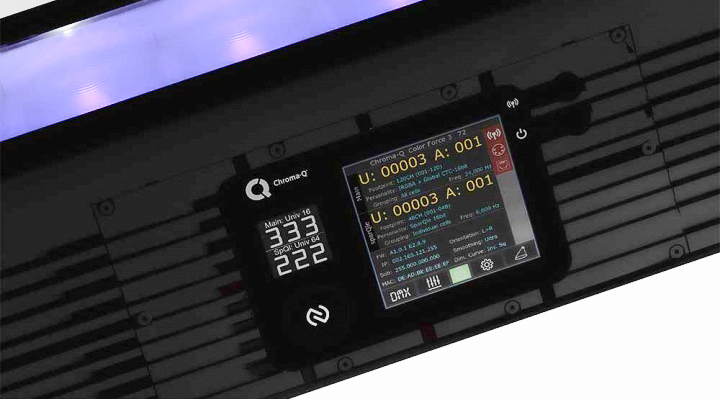
At this point, we feel we already have a comprehensive overview of the fixture, but the manufacturer has one last surprise in store. Alongside the NFC configuration interface and wireless control options, we discover a second small 1-inch monochrome display located next to the main touchscreen LCD. This e-ink screen displays essential fixture information: DMX address, fixture ID, DMX mode, or custom text.
The screen requires no power or battery to display the information, it remains visible even when the fixture is powered off. A touring technician can therefore skip labels and instantly check key information at any time. Of course, powering up the fixture is still necessary to modify the settings.
This new fixture entered production in March and will be available in spring.
More information at www.chroma-q.com